
Key takeaways
- Gas riding mowers with LED headlights help in low light, but wet grass needs care. Compare seven gas models with LED lights and wet-grass cutting guidance.
What's inside
As an Amazon Associate I earn from qualifying purchases. This post may contain affiliate links at no extra cost to you.
Wet grass is the hardest common condition a riding mower faces, and low light makes it harder. Damp blades stick together, clippings clump under the deck, tires slip on slopes, and a dull cut leaves torn tips that dry out unevenly. Add an early-morning or late-evening start, when the light is weak and shadows hide ruts and wet patches, and the job needs two things at once: a machine that can see, and an operator who knows how wet grass behaves. This guide looks at the best gas riding mowers with led headlights for wet grass conditions by pairing both halves of that job, seven gas models with LED headlights verified on maker or dealer pages, and plain guidance for cutting when the grass is damp.
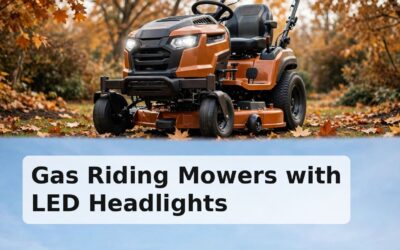
LED headlights on a riding mower are not a decoration. On a gas tractor, the headlights run off the charging system, so they stay on as long as the engine runs, and they throw a wide, white beam across the ground ahead of the deck. That beam shows ruts, wet patches, and the edge of the last pass, which matters most at dawn and dusk, when many owners cut to avoid the heat of the day. Every model in this set carries LED headlights as standard equipment or as a listed feature, and each product section says where that listing comes from.
Wet grass itself needs respect that no headlight can replace. The safest choice is always to wait for the grass to dry, and this guide says that plainly. When waiting is not possible, the right approach is to slow down, raise the deck, use side discharge instead of bagging or mulching, and clean the deck as soon as the cut is done. The buying guide below explains each of those steps in detail, and the product sections note which models handle damp conditions best, by deck design and engine power rather than by marketing language.
Quick verdict
For a large wet lawn, the John Deere S140 leads with a forty-eight-inch deck, a twenty-two-horsepower twin, and LED headlights, covering the most ground per pass while holding speed in damp growth. For a wet acre with trees and beds, the John Deere S120 leads on value, with the same LED lighting and twin-cylinder engine in a narrower forty-two-inch frame. For thick, wet grass that clogs decks, the Husqvarna TS 242XD leads with a welded ten-gauge ClearCut deck and a Kawasaki engine that holds speed when the load rises. The Cub Cadet XT2 GX54 D is the wide-deck pick for open wet lawns, with dual LED headlights and a fifty-four-inch fabricated deck.
| Product | Key spec | Best for |
|---|---|---|
| John Deere S140 | 22 hp V-twin, 48-in. Edge deck, LED headlights | Large wet lawns, most ground per pass |
| John Deere S130 | 22 hp V-twin, 42-in. Edge deck, LED headlights | Wet acre with trees and beds |
| John Deere S120 | 22 hp V-twin, 42-in. Edge deck, LED headlights | Value pick for damp morning cuts |
| Husqvarna TS 242XD | 21.5 hp Kawasaki, 42-in. ClearCut deck, LED lights | Thick wet grass, welded deck |
| Cub Cadet XT2 GX54 D | 26 hp Kohler 747cc, 54-in. deck, dual LED headlights | Wide open wet lawns |
| Cub Cadet XT2 LX46 | 22 hp Kohler 747cc, 46-in. deck, LED headlights | Middle-width wet lawns |
| Cub Cadet XT2 LX42 | 20 hp Kohler 747cc, 42-in. deck, LED headlights | Narrow wet lawns with obstacles |
How we chose
We picked gas models only, because a gas engine runs its headlights off the charging system for as long as the engine runs, with no battery pack to drain. Each model below has LED headlights verified on a maker page, a dealer page, or a review page we opened and read. Where a headlight claim rested on a single review, we note that in the product section rather than presenting it as a maker specification. Deck design mattered as much as lighting: a deck that moves clippings cleanly clogs less in damp grass, so we favored decks with shaped airflow and a wash port for cleaning after the cut.
Engine power also mattered, because wet grass loads the engine more than dry grass. Every model in this set carries at least twenty horsepower, and most carry a twin-cylinder engine, which holds speed better when the deck meets a thick, damp patch. We did not include any model under twenty horsepower, because a small engine slows and clogs sooner in wet conditions. The set runs from forty-two to fifty-four inches of deck width, so owners can match width to the shape of the lawn while keeping the same lighting and power baseline.
We also kept the wet-grass guidance separate from the product claims. No mower makes wet grass safe to cut at full speed, and no headlight changes the way damp blades behave. The guidance in this article comes from standard mowing practice: wait for dry grass when possible, slow down and raise the deck when not, discharge to the side, and clean the deck after the job. Each product section explains how that model fits the guidance, rather than claiming the model solves wet grass on its own.
John Deere S140
- Engine: 22 hp V-twin
- Deck: 48-in. Edge deck, 12-gauge steel, three-spindle
- Headlights: LED headlights, standard on the 100 Series
- Acreage: listed for up to two acres
- Blades: three-in-one blades for side discharge, mulching, or bagging
- Mulching: mulch cover optional; high-performance mulching blades available
The John Deere S140 is the widest model in this set, and width is its main advantage on a wet lawn. A forty-eight-inch deck covers more ground per pass, which means fewer passes through damp grass and less time with the deck loaded. The twenty-two-horsepower twin-cylinder engine holds speed when the deck meets a thick patch, and the three-spindle deck spreads the load across three blades instead of two, which keeps the cut even when the grass is heavy. The maker lists the S140 for lawns up to two acres, so a one-acre wet lawn sits comfortably inside its range.
The LED headlights on the S140 are standard equipment on the 100 Series, and the dealer page for this model lists bright LED headlights among its features. In low light, that beam shows the edge of the last pass and the wet patches ahead, which helps the operator keep a steady line instead of overlapping or missing strips. The three-in-one blades let the owner switch between side discharge, mulching, and bagging, and for wet grass the right choice is side discharge, which throws damp clippings clear of the deck instead of packing them inside. The mulching cover is optional, and owners who mulch wet grass will find it clogs sooner, so side discharge is the practical mode until the lawn dries.
Pros: Widest deck in this set; twin-cylinder engine holds speed in damp grass; LED headlights standard; three-spindle deck spreads the load.
Cons: Forty-eight-inch width needs a wide gate; mulching cover is optional; heavier than the forty-two-inch models.
John Deere S130
- Engine: 22 hp V-twin, model 44N677
- Deck: 42-in. Edge deck, 13-gauge stamped steel
- Headlights: LED headlights, standard on the 100 Series
- Mulching: listed for tough mowing, mulching, and bagging; mulch cover or high-performance plug
The John Deere S130 is the narrow-deck version of the same idea as the S140: the same twenty-two-horsepower twin-cylinder engine, the same LED headlights, and a forty-two-inch deck that fits through standard gates and between trees. On a wet acre with obstacles, the narrower deck is the better tool, because it turns tighter and trims closer to beds and fences without the operator swinging wide. The thirteen-gauge stamped deck is lighter than the fabricated decks in this guide, which keeps the machine nimble on damp ground where traction is already reduced.
The S130 is listed for tough mowing, mulching, and bagging, and its three-in-one blade setup gives the owner the same mode choices as the S140. In wet conditions, side discharge is again the right mode, and the forty-two-inch deck clogs less than a wider deck simply because it takes a narrower bite. The LED headlights are standard, so an early-morning cut starts with the same visibility as a midday cut. For a one-acre lawn with trees, this is the most balanced model in the set: enough engine for damp grass, a deck narrow enough for obstacles, and lights for low-light starts.
Pros: Same twin engine as the S140 in a narrower frame; LED headlights standard; tight fit around trees and beds; three-in-one blades.
Cons: Stamped deck rather than fabricated; narrower deck means more passes on open ground; mulch cover is a separate accessory.
John Deere S120
- Engine: 22 hp V-twin
- Deck: 42-in. Edge deck, 13-gauge stamped steel
- Headlights: LED headlights, standard on the 100 Series
- Blades: three-in-one blades for side discharge, mulching, or bagging
- Mulching: mulch cover optional; high-performance mulching attachment optional
The John Deere S120 is the value pick in this set, and it gives up almost nothing that matters for wet grass. It carries the same twenty-two-horsepower twin-cylinder engine and the same forty-two-inch Edge deck as the S130, with the same standard LED headlights. The differences are in trim and accessories rather than in cutting ability: the S120 is the simpler machine in the 100 Series, with fewer convenience features and a lower equipment level. For wet grass, the parts that matter, engine, deck, and lights, are the same.
That sameness is the argument for the S120. A damp morning cut needs power to hold blade speed, a deck that sheds clippings, and lights to see the ground ahead. The S120 has all three, and its forty-two-inch width suits a one-acre lawn with obstacles. Owners who want a wider deck should look at the S140, and owners who want a fabricated deck should look at the Husqvarna or Cub Cadet models below. Owners who want the lowest-cost way into a twin-cylinder, LED-equipped tractor for wet conditions will find the S120 covers the job.
Pros: Twin-cylinder engine and LED headlights at the value end of the range; forty-two-inch deck suits obstacles; three-in-one blades.
Cons: Stamped deck; fewer convenience features than the S130 and S140; mulch cover optional.
Husqvarna TS 242XD
- Engine: 21.5 hp Kawasaki FR Series
- Deck: 42-in. ClearCut fabricated deck, welded 10-gauge steel
- Headlights: LED lights
The Husqvarna TS 242XD is the heavy-deck pick for wet grass. Its forty-two-inch ClearCut deck is fabricated from welded ten-gauge steel, the thickest deck shell in this set, and that stiffness matters when damp grass packs under the deck and adds weight and drag. A stamped deck can flex under that load and scalp on uneven ground; a welded deck holds its shape. The twenty-one-and-a-half-horsepower Kawasaki FR Series engine is a commercial-grade twin that holds speed when the deck meets a thick, damp patch, and the ClearCut deck design moves clippings through the deck rather than letting them pack.
The LED lights on the TS 242XD are listed in review coverage of the model, and they serve the same purpose as the John Deere lights: visibility at dawn and dusk, when wet grass is most often cut. The forty-two-inch width keeps the machine nimble around trees and beds, and the fabricated deck suits owners whose lawn has rough patches or exposed roots. The trade-off is weight: a ten-gauge welded deck makes the machine heavier, and on soft, wet ground a heavier machine can leave marks more easily. Owners with soft soil should keep tire pressure at the maker setting and avoid sharp turns on damp turf.
Pros: Ten-gauge welded fabricated deck; Kawasaki FR Series engine; LED lights; strong in thick, damp grass.
Cons: Heavier than stamped-deck models; LED listing rests on review coverage rather than a maker page; weight can mark soft wet ground.
Cub Cadet XT2 GX54 D
- Engine: 26 hp Kohler 7000 HD, 747cc
- Deck: 54-in. AeroForce fabricated deck, 11-gauge steel
- Headlights: dual LED headlights
- Seat: adjustable 15-in. high-back seat with a 10-degree incline and arm rests
The Cub Cadet XT2 GX54 D is the most powerful model in this set, and the widest. Its twenty-six-horsepower Kohler engine is the largest here, and its fifty-four-inch AeroForce fabricated deck is the widest, which makes it the pick for a large, open, wet lawn where pass count matters most. The dual LED headlights are listed on the dealer page, and the adjustable high-back seat with arm rests keeps the operator comfortable through a long damp session. The eleven-gauge fabricated deck is welded rather than stamped, so it holds its shape when damp clippings pack underneath.
Power and width are the GX54 D's argument, and they come with a clear limit: a fifty-four-inch deck needs a wide gate, a wide storage bay, and open ground. On a lawn broken up by trees and beds, the wide deck spends its advantage on turning. On an open acre or larger lawn, it finishes the job in fewer passes than any other model here, and the twenty-six-horsepower engine holds blade speed through the thickest damp patches. The AeroForce deck shapes airflow to move clippings through, which helps in wet conditions, and the side-discharge mode is the right choice until the grass dries. For a big, open, wet lawn, this is the strongest cutting tool in the set.
Pros: Largest engine in this set; widest deck; dual LED headlights; fabricated eleven-gauge deck; comfortable adjustable seat with arm rests.
Cons: Fifty-four-inch width needs wide gates and open ground; heaviest machine in this set; overkill for a small or broken-up lawn.
Cub Cadet XT2 LX46
- Engine: 22 hp Kohler 7000 Series HD, 747cc
- Deck: 46-in. AeroForce fabricated deck, 11-gauge steel
- Headlights: LED headlights
The Cub Cadet XT2 LX46 sits in the middle of the width range, and the middle is often the right place. Its forty-six-inch AeroForce fabricated deck is four inches wider than the forty-two-inch models, which trims the pass count on open ground, yet it is eight inches narrower than the GX54 D, so it still fits through most gates and around most trees. The twenty-two-horsepower Kohler twin holds speed in damp grass, and the eleven-gauge fabricated deck resists the flex that damp clippings and uneven ground can cause in a stamped shell.
The LED headlights on the LX46 are listed in review coverage that names this model directly, and they give the same low-light visibility as the other models here. The AeroForce deck design moves clippings cleanly, which matters most when the grass is damp and prone to packing. For a one-acre lawn that is neither fully open nor heavily broken up, the LX46 is the balanced choice: enough width to save time, enough power for damp growth, and a deck stiff enough for rough patches. Owners with a fully open acre should look at the GX54 D; owners with a tight, tree-filled acre should look at the LX42 below.
Pros: Middle width suits most one-acre lawns; fabricated eleven-gauge deck; twin-cylinder engine; LED headlights.
Cons: LED listing rests on review coverage; no arm rests listed for this model; middle width is neither the fastest nor the nimblest.
Cub Cadet XT2 LX42
- Engine: 20 hp Kohler 7000 Series HD, 747cc twin-cylinder
- Deck: 42-in. AeroForce fabricated deck, 11-gauge steel
- Headlights: LED headlights
- Mulching: mulch kit available separately; Xtreme Mulching Kit listed for 42-inch fabricated decks
The Cub Cadet XT2 LX42 is the narrow-deck fabricated model in this set, and it suits a wet acre with many obstacles. Its forty-two-inch AeroForce deck is welded from eleven-gauge steel, so it holds its shape on rough, damp ground, and its twenty-horsepower twin-cylinder Kohler engine is the smallest twin in this set, which is still enough for a forty-two-inch cut in damp grass. The LED headlights are listed in the same review coverage that names the LX46, and the mulching kit is available separately for owners who want it.
The LX42's case is maneuverability plus deck strength. A forty-two-inch deck turns tighter and trims closer than any wider deck, and a fabricated deck takes the knocks that come with trimming close to trees, fences, and edging. In wet conditions, the narrower bite also means less grass under the deck at any moment, which lowers the chance of clogging. The trade-off is pass count: on open ground, the LX42 needs more passes than the wider models. For a wet lawn with beds, trees, and a narrow gate, that trade is worth making, because the time lost on passes is saved on turning.
Pros: Fabricated deck in a narrow width; twin-cylinder engine; LED headlights; narrow bite clogs less in wet grass.
Cons: More passes on open ground than wider models; mulch kit sold separately; twenty horsepower is the lowest twin output in this set.
Buying guide
The first rule of wet grass is the simplest: wait for it to dry when you can. Dry grass cuts cleanly, discharges freely, and leaves an even finish. Wet grass clumps, clogs, and tears. When waiting is not possible, because the lawn must be cut before a weekend event or because rain is forecast for days, the guidance below keeps the job as clean as the conditions allow.
Slow down. Blade tip speed is what cuts grass, and ground speed is what feeds grass into the deck. When the grass is wet, the deck needs more time per square foot, so the ground speed should drop by roughly a third. A slower pass gives the blades time to cut and the deck time to discharge, and it keeps the engine from bogging down. Owners who rush a wet cut will see the result in clumps left on the lawn and in strips where the blades tore rather than cut.
Raise the deck. Cutting wet grass at the lowest height packs the most material under the deck and leaves the shortest, most vulnerable grass behind. Raising the deck by one notch takes a smaller bite, which the deck can clear more easily, and leaves longer grass that dries faster and recovers better. A second, lower pass a day or two later, when the grass has dried, finishes the job more cleanly than a single low pass through wet growth.
Discharge to the side. Mulching and bagging both trap damp clippings inside the deck or the bagger, where they pack and clog. Side discharge throws the clippings clear, which keeps the deck open and the blades cutting. The clippings can be raked or left to dry and break down; either way, the deck stays cleaner than it would under a mulch plug or a full bagger. Every model in this set offers side discharge, and several offer it with three-in-one blades that switch modes without a blade change.
Clean the deck as soon as the cut is done. Wet clippings harden under the deck as they dry, and a hardened layer blocks airflow, adds weight, and holds moisture against the steel. A deck wash port makes the job quick: connect a hose, run the blades briefly, and rinse the underside. Without a wash port, a scraper and a hose do the same work. Either way, cleaning takes a few minutes and saves the deck over a season.
Watch traction and slopes. Wet grass is slippery, and a riding mower can slide on a slope that feels safe when dry. Keep the machine off steep slopes when the grass is wet, make turns slowly and in wide arcs, and avoid sudden stops that can break traction. LED headlights help in low light, but they do not change traction, so the operator should still treat every slope as a risk when the grass is damp.
FAQ
Should I mow wet grass at all?
Wait for the grass to dry whenever possible, because dry grass cuts cleanly and discharges freely. When waiting is not possible, slow down, raise the deck by one notch, discharge to the side, and clean the deck right after the cut. Avoid steep slopes when the grass is wet, since traction drops sharply on damp turf.
Do LED headlights help when mowing wet grass?
LED headlights help the operator see ruts, wet patches, and the edge of the last pass in low light, which matters for early-morning and late-evening cuts. They do not change how wet grass behaves under the deck, so the same wet-grass rules still apply: slow down, raise the deck, and discharge to the side.
Why does wet grass clog the deck?
Wet blades stick together and to the steel under the deck, which narrows the discharge path and packs clippings into a layer. A slower ground speed, a higher deck setting, and side discharge all reduce the amount of material under the deck at any moment, which keeps the discharge path open.
Is a twin-cylinder engine better for wet grass?
A twin-cylinder engine holds blade speed better than a single-cylinder engine when the deck meets a thick, damp patch, because it delivers power more evenly. Every model in this set carries at least twenty horsepower, and most carry a twin, which is the right baseline for wet conditions.
Should I mulch wet grass?
Mulching wet grass is the least effective choice, because damp clippings pack under the mulch plug and clog the deck. Side discharge is the practical mode for wet grass. Save mulching for dry conditions, when the clippings are light enough to fall through the turf.
How do I clean the deck after mowing wet grass?
Use the deck wash port if the model has one, or scrape the underside and rinse with a hose. Clean the deck right after the cut, before the clippings dry and harden. A clean deck cuts more evenly, discharges better, and lasts longer.
Conclusion
Wet grass and low light are a hard combination, and the seven gas models in this guide handle it by pairing LED headlights with the power and deck design that damp cutting demands. The John Deere S140 leads on width for large wet lawns, the S130 and S120 lead on value for a wet acre with obstacles, the Husqvarna TS 242XD leads on deck strength for thick damp growth, and the Cub Cadet XT2 models cover the middle and wide widths with fabricated decks and twin-cylinder engines. None of these machines makes wet grass safe to rush, and the guidance in this article matters as much as the model choice: wait for dry grass when possible, slow down and raise the deck when not, discharge to the side, and clean the deck after the job. Pick the deck width that fits the lawn, the engine that holds speed in damp growth, and the lights that let the operator see the ground ahead, and the wet cut will come out as clean as the conditions allow.
Related guides
More from Amazon
Programs that pair well with the guide above. Offers and eligibility are set by Amazon and may change.
Collect the home and kitchen items you want in one registry that guests can shop from.
Create a wedding registrySet up recurring deliveries of everyday items on eligible products. Terms and savings are set by Amazon.
Explore Subscribe & SaveFree shipping on eligible items, Prime Video and more. Eligible new members can start with a free trial.
Start a Prime free trialAudiobooks and podcasts to listen to on the go. Eligible new members can start with a free trial.
Try Audible freeAs an Amazon Associate we earn from qualifying purchases.
More ways to save on your garden
Programs that pair well with the guide above. Offers and eligibility are set by Amazon and may change.
Fast, free shipping on eligible items, plus Prime Video and more. Eligible new members can start with a free trial.
Start a Prime free trialSet up recurring deliveries of everyday items on eligible products. Terms and savings are set by Amazon.
Explore Subscribe & SaveRead from a huge library of eBooks, including how-to guides and cookbooks. Eligible new members can start with a free trial.
Try Kindle UnlimitedAudiobooks and podcasts for the commute, the garage or the kitchen. Eligible new members can start with a free trial.
Try Audible freeAs an Amazon Associate we earn from qualifying purchases. Using these links costs you nothing extra.

Write Your Review
No reviews yet. Be the first to share your experience!