
Key takeaways
- Commercial broadcast spreaders for professional landscaping routes, from a 50 lb Spyker to a 160 lb SnowEx, compared on hopper size, frames and gate controls.
As an Amazon Associate I earn from qualifying purchases. This post may contain affiliate links at no extra cost to you.
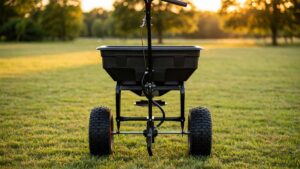
A route spreader lives a harder life than any homeowner machine. The best commercial broadcast spreaders for professional landscaping routes get loaded at dawn, bounced across a trailer, pushed over wet turf, damp fertilizer dust settling into every joint, then rinsed — or not — and loaded again the next morning. On a route with eight or ten properties before lunch, the spreader is not a purchase, it is a piece of crew equipment, and the features that matter are the ones that survive repetition: a frame that does not flex under a full hopper, bearings that keep rolling after a season of grit, a gate that opens to the same setting every time, and tires with enough air and diameter to cross a rough lawn without the operator wrestling the load.
The five spreaders below were each verified on their opened product pages, and they cover the working range of route sizes. Two are Spyker ERGO-PRO machines, the line most often specified by lawn care fleets, in 50 and 80 pound sizes. The TerraKing 70 pound unit brings a stainless frame and a direct-rod gate at a mid-route size. The SnowEx SP-85 is the heavy hauler at 160 pounds for pelletised material and winter route work. The Garvee 100 pound stainless-hopper model is the honest budget entry, the second-unit or new-crew spreader. What they share is the broadcast pattern the keyword asks for — a spinning distribution across a wide swath — as opposed to drop spreaders, which were checked and deliberately left out of this list.
Quick verdict
For most two-person route crews, the Spyker ERGO-PRO SPY50L-1P kit is the centre of gravity: a 50 pound hopper that one operator can load and push all morning, the Spyker Dial calibration system, and a handle that adjusts to the operator's height. The TerraKing 70 pound is the value pick with professional bones — stainless frame, pneumatic tires and a direct-rod gate that holds its setting. The Spyker SPY80-1S in stainless is the buy-once flagship for high-volume routes. The SnowEx SP-85 serves the biggest properties and doubles as a winter pellet and de-icer unit. The Garvee is the low-cost way to put a second spreader on the truck.
At a glance
| Model | Hopper capacity | Frame / hopper | Tires | Standout point |
|---|---|---|---|---|
| TerraKing Commercial (Agri-Fab 45-0563) | 70 lb | Stainless steel frame | 13 x 5 in pneumatic | Direct-rod gate, about 14,000 sq ft per fill |
| Spyker ERGO-PRO SPY50L-1P kit | 50 lb | Impact-resistant hopper | Large pneumatic | Spyker Dial calibration, height-adjust handle |
| Spyker ERGO-PRO SPY80-1S | 80 lb | All-welded stainless frame | Pneumatic | Stainless flagship, made in USA |
| SnowEx SP-85 | 160 lb | Walk-behind broadcast frame | 13-5.00 x 6 pneumatic | 10-blade spinner, pellet and de-icer work |
| Garvee walk-behind | 100 lb (45 L) | Stainless steel hopper | Thickened all-terrain rubber | Low-cost second unit, parts pre-assembled |
How we chose
The gates for this keyword were commercial, not cosmetic. Each spreader had to be a walk-behind broadcast model — spinner distribution, not a drop pattern — with a hopper sized for route work rather than a single small lawn. Construction evidence had to appear on the opened page: frame material, tyre type and size, gate control style, and any calibration system. Pages were read for the details a fleet buyer actually checks, such as bearing type, whether the gate is driven by a positive rod or a cable, and whether the hopper shape sheds material toward the gate or bridges over it.
Two exclusions are worth stating plainly. Drop spreaders were left out even when the brand was right — the Spyker Pro-Series P70-12010 is a fine machine, but it lays a drop pattern, and this keyword asks for broadcast. Winter-only salt spreaders were also left out of the main list; the SnowEx earns its place because the maker lists it for pelletised materials as well as de-icers, which makes it a year-round route tool rather than a seasonal one. Where a sibling article in this programme already used a model — the EarthWay 2150 and 2030P-Plus, the Lesco 101186, the Chapin 80 pound SureSpread — it was not repeated here, so this set stands on its own for route buyers comparing fresh options.
TerraKing Commercial 70 lb Broadcast Spreader (Agri-Fab 45-0563)
- Hopper capacity: 70 lb
- Frame: stainless steel
- Tires: 13 x 5 inch pneumatic
- Bearings: UHMW
- Gate control: direct rod on/off
- Coverage: about 14,000 square feet per fill
- Assembly: no tools required
- Maker: built by Agri-Fab in Sullivan, Illinois
The TerraKing is the spreader that reads like it was specified by someone who has cleaned fertilizer out of a seized gate at 6 a.m. The frame is stainless steel, which shrugs off the corrosion that eats painted mild steel in a season of damp product. The gate is worked by a direct rod rather than a cable, and that single choice removes the most common route complaint: cable stretch and fray quietly changing the application rate between the first lawn and the fifth. A rod opens the gate to the same place every time, and the on/off action is positive enough to work with gloves on.
The maker lists coverage of about 14,000 square feet per fill from the 70 pound hopper, which maps neatly onto a route of average suburban properties — roughly three to four typical lawns between refills, depending on rate. The 13 x 5 inch pneumatic tires are properly sized for turf work, rolling over ruts and sprinkler heads instead of digging in, and the UHMW bearings are a sensible choice for a gritty environment because the material tolerates dust that would grind a cheap bushing. Assembly needs no tools, which matters when a unit is unboxed at the yard rather than the workshop. For a growing crew stepping up from homeowner spreaders, this is the professional pattern at a mid-route size.
Pros
- Stainless frame resists fertilizer corrosion
- Direct-rod gate holds its setting across a route
- About 14,000 square feet per fill
- UHMW bearings tolerate dust and grit
Cons
- 70 lb hopper is mid-size for very large properties
- Fewer dealer shelves stock it than Spyker
- No enclosed gearbox claims on the page
Spyker ERGO-PRO SPY50L-1P 50 lb Spreader Kit
- Hopper capacity: 50 lb
- Calibration: Spyker Dial system
- Hopper: bridge-free, impact-resistant design
- Tires: large pneumatic
- Handle: adjusts for operators from 5 ft 3 in to 6 ft 6 in
- Extras: support stand fits rear platform carriers; kit includes a 25 lb bag spreader
- Weight: 40 pounds
If one spreader defines the modern route standard, it is the 50 pound ERGO-PRO. The Spyker Dial is the headline: a calibration dial that sets the gate opening by number, so the rate a crew lead dialled in on Monday is the rate the newest hire applies on Friday, and switching between products on the same route becomes a number change rather than a guessing session. The hopper is shaped to be bridge-free, meaning material keeps flowing toward the gate instead of arching over it and starving the spinner — the stop-and-shake interruption that breaks a route's rhythm. The hopper material is impact-resistant, built for trailer life.
The ergonomic details are route details. The handle adjusts across a wide height range, so the same unit fits every operator on the crew without a hunched posture by the tenth lawn. The support stand is shaped to fit rear platform carriers, which is how many route trucks actually carry a spreader between stops. This listing is the All Season kit, which adds a 25 pound bag spreader for spot work and small patches. At 50 pounds of capacity the hopper needs refilling more often than the 80 pound machines, and that is the honest trade: in exchange, a full load stays pushable on soft or sloped turf late in the day when legs are tired.
Pros
- Spyker Dial gives repeatable numbered settings
- Bridge-free hopper keeps material flowing
- Handle adjusts to the operator's height
- Kit adds a 25 lb bag spreader for spot work
Cons
- 50 lb capacity means more refills on big routes
- Premium pricing for the class
- Dial settings still need a catch-tray check per product
Spyker ERGO-PRO SPY80-1S 80 lb Stainless Spreader
- Hopper capacity: 80 lb
- Frame: all-welded stainless steel
- Weight: 43 pounds
- Origin: made in USA
- Line: ERGO-PRO professional series
The SPY80-1S is the stainless flagship of the ERGO-PRO line: an 80 pound hopper over an all-welded stainless steel frame, at a unit weight of 43 pounds that stays manageable on the trailer ramp. Stainless is the material decision that defines this machine's service life. Fertilizer dust is hygroscopic and corrosive; it pulls moisture from the air and holds it against the frame, and a painted frame eventually blisters at every stone chip. A stainless frame removes that failure mode from the maintenance list, which is why fleet buyers who keep spreaders for many seasons specify it.
The 80 pound capacity changes route maths. Fewer refill stops means the operator's walking is productive walking, and on properties measured in acres rather than square feet the bigger hopper is the difference between one load and three. The ERGO-PRO line's ergonomics carry over from the 50 pound model. A note for buyers comparing listings: this programme's sibling article on large properties used the SPY80-1P, the standard-frame variant of this same 80 pound platform; the model here is the distinct stainless-frame version, chosen for this route-focused list because frame corrosion is the route environment's main long-term cost. For a high-volume crew, this is the buy-once spreader.
Pros
- All-welded stainless frame for long service life
- 80 lb hopper cuts refill stops on large routes
- 43 lb unit weight is manageable on ramps
- Made in USA
Cons
- Highest commitment in this list alongside the SnowEx
- Stainless frame is more spreader than small crews need
- Listing page is brief; confirm dial and tyre spec with the seller
SnowEx SP-85 160 lb Broadcast Spreader
- Hopper capacity: 160 lb
- Spinner: 10-blade design with agitator and wire grid
- Gate: slide gate with handle-mounted lever
- Tires: 13-5.00 x 6 pneumatic
- Materials listed by the maker: de-icers, salt, sand and pelletised materials
- Role: high-capacity route and winter work
The SnowEx SP-85 is the heavy end of walk-behind broadcasting. At 160 pounds of capacity it carries roughly double the Spyker 80, and it is built around materials handling rather than fine lawn calibration: a 10-blade spinner throws a wide, even pattern, an agitator keeps material moving in the hopper, and a wire grid breaks up lumps before they reach the gate. The maker lists de-icers, salt, sand and pelletised materials, which makes the SP-85 the one machine in this list that works a winter route as readily as a summer one — pelletised lime, pellet fertilizer and ice melt through the same gate.
The slide gate is worked by a handle-mounted lever, so the operator opens and closes flow without breaking stride, and the 13-5.00 x 6 pneumatic tires are sized for a genuinely heavy load on wet ground. The honest framing is that this is a capacity tool, not a precision lawn instrument: a crew feeding it pelletised product on large commercial properties, campuses and winter contracts will use everything it offers, while a crew applying fine seed on small lawns should look at the Spyker dial machines instead. On the right route, though, nothing else here moves as much product per fill.
Pros
- 160 lb capacity, the largest in this list
- Agitator and grid handle lumpy material
- Maker lists pelletised material and de-icers alike
- Handle-mounted gate lever works at walking pace
Cons
- A full load is heavy to push on soft ground
- Less about fine calibration than the Spyker pair
- Over-sized for small-lawn routes
Garvee 100 lb Walk-Behind Broadcast Spreader
- Hopper capacity: 100 lb, 45 litre stainless steel hopper
- Flow control: handle-mounted knob
- Tires: thickened all-terrain rubber
- Assembly: main parts pre-assembled
- Weight: 36.6 pounds
Every fleet has a second-spreader problem: the day two crews need to run at once, or the new hire needs a machine that is not the flagship. The Garvee answers it at the low-cost end with a specification that is better than its price suggests — a 100 pound, 45 litre stainless steel hopper, a handle-mounted flow knob, and thickened all-terrain rubber tires. The stainless hopper matters at this end of the market, where painted thin steel is the norm and one damp season in a truck bed can start the rust that ends a cheap spreader's life.
The main parts arrive pre-assembled, so the unit goes from box to route quickly, and at 36.6 pounds it is easy to load and unload. The flow control is a simple knob rather than a numbered calibration dial, so rate discipline on a Garvee means a catch-tray check and a marked setting for each product — a fair routine for a backup or a single-product crew. It will not match the Spyker machines for refinement, and this article does not pretend otherwise. As the spare that keeps a route moving when the main spreader is down, or the first commercial-size unit for a solo operator adding a second route day, it earns its place.
Pros
- Stainless hopper at a budget position
- 100 lb capacity suits full route days
- Main parts pre-assembled
- Light 36.6 lb unit weight
Cons
- Flow knob lacks a numbered calibration dial
- Brand support network is thinner than Spyker or Agri-Fab
- Long-term durability evidence is limited
Buying guide
Match hopper size to route shape, not to ambition. A 50 pound hopper refilled from bags staged on the truck suits dense suburban routes where properties are close and the truck is never far away. An 80 or 100 pound hopper earns its keep when properties are large or far apart, and the 160 pound SnowEx belongs on commercial sites and winter contracts. Remember that the operator pushes the full weight: an 80 pound load on wet, sloped turf is a workout by the eighth property, and crews rotate operators on big-hopper routes for a reason.
Frame material is the long-term money decision. Fertilizer and de-icer dust corrode; stainless frames — the TerraKing, the SPY80-1S, the Garvee's hopper — remove the most common end-of-life failure from the list. Gate control is the accuracy decision. A direct rod (TerraKing) or a numbered dial (Spyker) holds a setting across a route and across operators; a plain knob (Garvee) works when one operator runs one product and marks the setting. Whatever the control, calibrate per product with a catch tray over a measured area at the start of each season and whenever the product changes — prill size and density vary enough between brands to move a rate by a fifth.
Tires and bearings decide how a spreader feels in month eighteen. Pneumatic tires in the 13 inch class roll over turf obstacles and absorb the trailer-yard bumps that crack solid wheels; keep them inflated, because a soft tyre narrows the pattern on one side. Bearings and spinner shafts live in fertilizer dust, so rinse the machine after use, let it dry before it goes back on the truck, and read any spinner wobble as a same-week repair — a wobbling spinner throws a striped pattern that shows up in the lawn a fortnight later. Finally, standardise where you can: a crew running two spreaders of the same dial system shares settings, spares and habits, which is worth more on a wet Tuesday than any single specification.
FAQ
What size spreader suits a typical suburban route?
A 50 to 80 pound hopper is the working range. The 50 pound Spyker suits dense routes with the truck nearby; the 70 pound TerraKing and 80 pound Spyker suit mixed routes where refills cost walking time. Above that, the Garvee 100 and SnowEx 160 serve large or commercial properties.
Is stainless worth paying for on a route spreader?
For equipment that lives with fertilizer dust daily, yes. Corrosion at the frame and gate is the most common reason a hard-used spreader retires, and stainless removes that failure mode. A homeowner spreading twice a year will never see the difference; a route crew will.
Broadcast or drop — which does a landscaping route need?
Broadcast, for almost all route work. A broadcast spreader covers ground far faster with a wide swath and tolerates slight overlaps. Drop spreaders have a place on small, tight lawns and near beds where throw must be contained, but they are the specialist tool, not the route standard — which is why the drop models checked for this article were left out.
How often should a route spreader be calibrated?
At the start of each season, at every product change, and after any gate or cable work. Catch the output over a measured run, weigh it, and record the dial or rod setting against the product name in the truck book. Five minutes of calibration is cheaper than a striped lawn or a burnt one.
Can one spreader handle both fertilizer and winter de-icer?
The SnowEx SP-85 is listed by its maker for de-icers, salt, sand and pelletised materials, so it is the dual-season choice here. Granular fertilizer and salt differ in density, so recalibrate at the changeover, and rinse the machine thoroughly between seasons — salt residue is the most corrosive load a spreader carries.
What maintenance keeps a route spreader accurate?
Rinse after use, dry before storage, keep pneumatic tires at pressure, check the gate for full closure with product dust cleared out, and spin the impeller by hand weekly to feel for bearing roughness. Most accuracy problems trace back to a gate that no longer fully closes or a spinner that no longer spins true.
Conclusion
A route spreader earns its money in the unglamorous details: a gate that repeats, a frame that shrugs off corrosive dust, tires that roll a full load over wet turf. The Spyker SPY50L-1P kit is the balanced standard for most crews, the TerraKing 70 brings stainless and a direct-rod gate at a mid size, and the stainless SPY80-1S is the long-service flagship. The SnowEx SP-85 hauls pelletised material and winter loads nothing else here can match, and the Garvee puts a stainless 100 pound hopper on the truck as a capable second unit. Choose by route shape, calibrate by product, rinse after every day — and any of these five will still be spreading true long after a homeowner machine would have been retired.
Write Your Review
No reviews yet. Be the first to share your experience!