
Key takeaways
- Five genuine drop spreaders on pneumatic wheels, from a 200 lb walk-behind to a tow-behind acre machine, compared on hopper size, spread width and frame build.
What's inside
As an Amazon Associate I earn from qualifying purchases. This post may contain affiliate links at no extra cost to you.
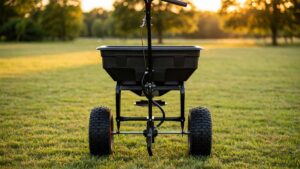
A large suburban yard is where a drop spreader earns its keep and where its wheels get found out. The best drop fertilizer spreaders with pneumatic wheels for large suburban yards have to do two things at once: lay material in a controlled band exactly the width of the hopper, with no throw onto driveways, beds or the neighbor's side of the line, and roll that load across half an acre of real lawn without the wheels digging in, bouncing the gate setting around, or leaving ruts in soft spring ground. Air-filled pneumatic tires are the traditional answer to the second half of that brief, because the tire flexes over bumps and spreads the machine's weight over a wider footprint than a hard plastic or solid rubber wheel.
The pairing is rarer than it sounds. Most walk-behind spreaders sold for lawns are broadcast models, and most drop spreaders that do exist ride on solid or never-flat wheels. Every model in this roundup passed both gates on its own opened page: the maker or retailer states it is a drop spreader, and the maker or retailer states pneumatic tires or wheels for that model. Models that failed either gate were left out however good they looked, and the near misses are named in the How we chose section so the size of the genuine pool is on the record.
What remains is a short, honest list with a commercial flavour: a 200 lb walk-behind built for wide paths, a side-by-side professional drop spreader that can work at two widths, a tow-behind that covers an acre per fill, and two sizes of the long-running Gandy Turf Tender line. Three of the five appeared in an earlier sibling roundup on drop spreaders for lawns with flower beds; that overlap is disclosed under each repeat, because in a pool this small, pretending otherwise would help nobody.
Quick verdict
The Spyker P70-12010 is the most versatile walk-behind here, with two hopper sections that spread at 18 or 36 in, oversized 13 by 5 in pneumatic turf tires and two interchangeable bottom plates for fine and coarse material. The Buyers Products SaltDogg WB400 is the heavy lifter, a 200 lb walk-behind with a 44 in drop path and stainless workings. For the biggest suburban lots, the Agri-Fab 45-0288 tow drop spreader covers up to about an acre per fill behind a lawn tractor. The Gandy Turf Tender 36H13 is the precision instrument of the group, and its smaller 24H13 sibling brings the same metering design down to a handier size.
| Product | Key spec | Best for |
|---|---|---|
| Spyker P70-12010 Pro-Series Drop Spreader | 120 lb, 18 or 36 in widths, 13×5 in pneumatic turf tires | Two-width flexibility on foot |
| Buyers Products SaltDogg WB400 | 200 lb, 44 in drop path, 13 in pneumatic tires | Widest walk-behind passes |
| Agri-Fab 45-0288 Tow Drop Spreader | 175 lb tow-behind, 42 in width, up to 40,000 sq ft | Acre-sized lots behind a tractor |
| Gandy Turf Tender 36H13 | 36 in push, about 120 lb, 13 in pneumatic wheels | Precision rate work |
| Gandy Turf Tender 24H13 | 24 in push, about 78 lb, 13 in pneumatic wheels | Smaller yards, same metering design |
How we chose
Both gates were applied per model on pages opened for this article. Gate one: the product is a true drop spreader, meaning material falls by gravity through openings along the hopper bottom in a band the width of the machine, rather than being flung by a spinning impeller. Gate two: pneumatic wheels or tires are stated for that model by the maker or a retailer listing its specifications. Solid rubber, foam-filled and never-flat wheels did not pass gate two, and broadcast models with drop-style rate dials did not pass gate one.
The near misses show how thin the genuine pool is. The Scotts Turf Builder Classic Drop is a genuine drop spreader, but its wheels are not pneumatic. A widely sold 60 lb unbranded drop spreader rides on never-flat tires. The At Home 75 lb drop spreader likewise lists 10 in never-flat tires. A VEVOR 50 lb model mixes broadcast and drop language in its own listing and could not be confirmed as a true drop design. Those exclusions, plus the commercial tilt of what remains, are why three picks repeat from the sibling roundup on drop spreaders for lawns with flower beds: the Spyker, the Agri-Fab and the Gandy 36H13 all appeared there, and each repeat is disclosed under its heading. The Gandy 24H13 is a distinct, smaller model from the same Turf Tender line, not a second helping of the 36H13; its capacity, width and openings all differ and are listed separately.
Capacity and width were read as the working pair for large yards. A big hopper on a narrow machine still means many passes; a wide machine with a small hopper means many refills. The five picks balance the two differently, and the buying guide below walks through the maths of matching them to a real lot size.
Spyker P70-12010 Pro-Series Side-by-Side Drop Spreader
- Type: walk-behind drop spreader with two side-by-side hopper sections
- Capacity: 120 lb all-steel hopper per the retailer listing
- Spread widths: 18 in or 36 in, using one or both sections
- Wheels: 13×5 in pneumatic turf-tread tires per the retailer listing
- Bottom plates: two interchangeable steel plates, one for smaller granules such as grass seed, one with larger holes for ice melt and coarse material
- Frame: powder-coated steel; machine weight 65 lb per the earlier sibling research on the same listing
- Repeat disclosure: also featured in the sibling roundup on drop spreaders for lawns with flower beds
The Spyker's party trick is flexibility. Its hopper is split into two side-by-side sections, so the operator can spread a full 36 in band across open lawn or shut one side down and work an 18 in band along beds, paths and fence lines without changing machines. The retailer listing states the wheels plainly: large 13 by 5 in pneumatic tires with a turf tread that distribute weight evenly, which is the detail that matters when a 120 lb hopper is full of dense fertilizer and the lawn is soft. Two interchangeable steel bottom plates come in the box, the finer one for grass seed and small granules, the coarser one for ice melt and larger material, and the AccuWay adjustment mentioned on the listing helps center the pattern. For a large suburban yard with both open lawn and fiddly edges, this is the most adaptable walk-behind of the five.
Pros:
- Two working widths from one machine, 18 in or 36 in
- Oversized pneumatic turf tires spread a full hopper's weight gently
- Two bottom plates cover fine seed and coarse melt material
- All-steel hopper and powder-coated frame suit commercial-grade use
Cons:
- Premium pricing for a walk-behind spreader
- 120 lb capacity still means refills on the largest lots
- Steel hopper needs a rinse and dry after corrosive materials
Buyers Products SaltDogg WB400 Walk Behind Drop Spreader
- Type: walk-behind drop spreader, low-to-the-ground design
- Capacity: 2.5 cu ft poly hopper, holds up to 200 lb of bagged material per the product page
- Spread path: 44 in per the product page
- Wheels: 13 in pneumatic tires per the product page
- Build: stainless steel frame, agitator and trough; nylon bushings
- Extras: hopper screen, solid linkage flow lever, plastic rain cover; arrives 90 percent assembled per the product page
The WB400 is the biggest walk-behind here, and it arrives from the winter-maintenance side of the Buyers catalogue, where drop spreaders are sold for salt and ice melt on paths. Nothing about that origin disqualifies it for fertilizer and seed: the product page describes a low-to-the-ground drop design that keeps material exactly where it is placed and away from sensitive foliage, a 44 in profile that can cover a full path in one pass, and a solid linkage lever to fine-tune discharge. The stainless frame, agitator and trough shrug off corrosive material, the included screen keeps lumps from jamming the openings, and the 13 in pneumatic tires are described on the page as providing stability on uneven surfaces. One honest framing note: the maker positions this model for sidewalks, driveways and property maintenance, so its rate guidance leans toward salt work, and lawn users should calibrate with their own material before the first full run.
Pros:
- Largest walk-behind capacity here at 200 lb, with the widest 44 in path
- Stainless workings resist corrosive fertilizer as well as salt
- Screen, rain cover and solid linkage included
- Arrives 90 percent assembled per the maker
Cons:
- Marketed for ice melt, so lawn rate charts need a self-made calibration pass
- Heavy machine when the hopper is full, even on pneumatic tires
- Poly hopper is 2.5 cu ft, so bulky light materials fill it fast
Agri-Fab 45-0288 Tow-Behind Drop Spreader
- Type: tow-behind drop spreader with universal hitch
- Capacity: 175 lb, 17-gallon dry hopper per the product page
- Spread width: 42 in controlled width per the product page
- Coverage: approximately 40,000 sq ft, up to about 1 acre per fill per the product page
- Wheels: pneumatic tires per the maker's instruction manual specification table
- Build: rustproof poly hopper, galvanized steel agitator; built in Sullivan, Illinois per the maker
- Repeat disclosure: also featured in the sibling roundup on drop spreaders for lawns with flower beds
For a suburban lot that runs toward an acre, walking any spreader gets old, and the Agri-Fab is the tow-behind answer. It hitches to a lawn or garden tractor, carries 175 lb in a rustproof poly hopper, and lays a controlled 42 in band for roughly 40,000 sq ft per fill according to the product page. The maker's instruction manual specification table lists the tire type as pneumatic, which is the gate-two evidence for this model; secondary sources disagree on the exact tire size, so no size is claimed here. A galvanized steel agitator keeps material moving in the hopper. Because the wheels drive the metering, steady towing speed is the operator's main job: the manual advises a safe, consistent speed of about 3 mph for even distribution, which is worth knowing before the first pass rather than after a striped lawn explains it.
Pros:
- Covers up to about an acre per fill behind a tractor
- 42 in controlled band suits long, straight suburban runs
- Rustproof poly hopper and galvanized agitator handle fertilizer well
- Universal hitch fits lawn and garden tractors across brands
Cons:
- Needs a tractor or riding mower to tow it
- Evenness depends on holding a steady towing speed
- Tow-behind width is clumsy in tight, gated side yards
Gandy Turf Tender 36H13 Variable Rate Drop Spreader
- Type: push drop spreader, variable rate
- Width: 36 in, with 30 openings spaced along the bottom per the maker's parts documentation
- Capacity: 1.8 cu ft hopper, approximately 120 lb of fertilizer per the maker's catalog
- Wheels: 13 in pneumatic wheels per the maker's catalog and parts list
- Metering: adjustable stainless steel snap-off bottom and slide with triangular openings; steel tri-bar rotor agitator; positive shutoff lever; rate chart included
- Repeat disclosure: also featured in the sibling roundup on drop spreaders for lawns with flower beds
Gandy builds drop spreaders for golf and turf professionals, and the 36H13 shows it. The maker's documentation describes a stainless snap-off bottom and slide with triangular openings, a steel tri-bar rotor for internal agitation, and a positive shutoff lever that stops flow cleanly at the end of a pass, which is exactly where amateur machines dribble a scorch line across the lawn. The catalog lists the push model with 13 in pneumatic wheels and an overall width of 46 in with those tires fitted. Rate setting follows the included chart rather than a vague dial number, and the snap-off bottom removes for cleaning, a small mercy after spreading anything dusty or corrosive. This is the precision pick: slower to set up than a big-box machine, and more accurate once set.
Pros:
- Professional metering hardware: stainless bottom, tri-bar rotor, positive shutoff
- Rate chart guidance rather than guesswork dial settings
- Snap-off bottom makes cleaning thorough and quick
- 13 in pneumatic wheels on a 36 in frame roll softly over turf
Cons:
- Sold through turf suppliers rather than big-box shelves
- Premium pricing for the capacity class
- Chart-based calibration asks for a careful first setup
Gandy Turf Tender 24H13 Variable Rate Drop Spreader
- Type: push drop spreader, variable rate
- Width: 24 in, with 20 openings along the bottom per the maker's catalog
- Capacity: 1.2 cu ft hopper, approximately 78 lb of fertilizer per the maker's catalog
- Wheels: 13 in pneumatic wheels per the maker's catalog; retailer listings confirm 13 in pneumatic wheels on the 24 in model
- Metering: same adjustable stainless snap-off bottom, tri-bar rotor and positive shutoff design as the 36 in model
- Kinship disclosure: the smaller model in the same Turf Tender line as the 36H13 above; a distinct model with its own capacity, width and opening count
The 24H13 is the same metering idea in a smaller frame. Gandy's catalog lists the 24 in push model with 13 in pneumatic wheels, a 1.2 cu ft hopper holding roughly 78 lb of fertilizer, and 20 openings across its width, and current turf-supplier listings for the Gandy drop spreader range repeat the 13 in pneumatic wheel figure for the 24 in size. For a large yard, 24 in is the narrow end of sensible, and this model earns its place for the yards where the work is mostly long side strips, verge sections and the runs between beds, where a 36 or 44 in machine simply does not fit its band. It is also the easiest of the five to store and to push at the end of a long day. Buyers choosing between the two Gandys should let gate widths and strip widths decide, not price alone.
Pros:
- Same stainless metering system as its larger sibling
- 24 in band fits side strips and gated sections the wide machines cannot use
- Lightest and easiest to store of the five
- 13 in pneumatic wheels keep the gentle footprint of the bigger models
Cons:
- 24 in width means many passes on open lawn
- About 78 lb capacity means frequent refills with dense material
- Turf-supplier distribution, like its sibling
Buying guide
Match the machine to the lot first. For lots up to roughly half an acre with open runs, a walk-behind in the 120 to 200 lb class, such as the Spyker or the WB400, balances refill count against push effort. For lots approaching an acre, the tow-behind Agri-Fab turns the job into seat time, provided a tractor or riding mower is already in the shed. Width is the second half of the same decision: a 42 or 44 in band halves the passes of a 24 in band on open lawn, but the wide machine is wasted, and sometimes unusable, where the yard is a chain of narrow side strips. Measure the gates and the narrowest run before falling for the widest hopper.
Understand what the pneumatic wheel is doing for the application, beyond comfort. A drop spreader's rate depends on ground speed and gate opening, and a hard wheel bouncing over bumps varies both. An air-filled tire rolls over small ridges instead of hopping them, keeps the hopper steadier, and spreads the loaded weight so soft spring turf is less likely to rut. The trade-off is maintenance: pneumatic tires need their pressure checked, and a puncture is possible in a way it never is with a solid wheel. Turf-tread patterns, such as the one the Spyker listing describes, grip without chewing the surface.
Read the metering hardware before the capacity number. Stainless or snap-off bottoms, real agitators and positive shutoff levers are what separate an even application from a striped one, and they are also what survive corrosive fertilizer season after season. A rate chart written for the machine beats a generic dial. Whatever the model, run a calibration pass on a driveway or tarp with the actual product being spread: weigh what comes out over a measured area, adjust, and only then take it to the lawn. Drop spreaders forgive many things, but a wrong gate setting is applied perfectly evenly at the wrong rate.
Mind the material. Drop spreaders handle granular fertilizer, seed and powdered or pelletised products that flow freely; damp, lumpy or very dusty material bridges over openings and starves the band. Screens, such as the one included with the WB400, help with lumps. After any session with fertilizer or melt product, empty the hopper, rinse steel parts, dry the machine and store it under cover. The stainless and poly builds in this roundup tolerate that routine well; painted steel asks for a little more care with drying.
Finally, be honest about the category. A drop spreader is a precision tool that trades speed for placement. If the yard has no beds, borders or water features to protect, a broadcast spreader will always be faster. The owners who love drop machines are the ones feeding lawns that touch flower beds, paths, patches of ornamental planting or a neighbor's boundary, where every granule outside the band is either waste or damage. On a large suburban yard of that shape, a pneumatic-wheeled drop spreader is not a compromise; it is the right tool.
FAQ
Why do pneumatic wheels matter more on a drop spreader than on a broadcast spreader?
A broadcast spreader throws material outward, so small bounces mostly blur an already wide pattern. A drop spreader meters material through openings as the wheels turn and the machine moves, so a hopping wheel and a surging pace show up directly as thick and thin bands. The air-filled tire also carries a full hopper's weight over a wider footprint, which protects soft turf. That is why this roundup required the pneumatic statement model by model instead of letting wheels pass as a minor detail.
How wide should the spreader be for a large suburban yard?
Let the narrowest regular run decide the maximum width, and the open area decide whether that width is tolerable. A 42 or 44 in machine on a half-acre of open lawn is efficient; the same machine is a liability if every pass threads a 30 in gate. Mixed yards are why the Spyker's two-width hopper exists, and why the 24 in Gandy stays in this list despite its extra passes.
Can these drop spreaders handle grass seed as well as fertilizer?
Yes, with the right bottom openings. Fine seed needs smaller openings than coarse fertilizer, which is why the Spyker ships with two interchangeable bottom plates and the Gandy bottom adjusts and snaps off for cleaning and setup. Very light seed also benefits from a calm day and a steady pace, since the band is only as even as the walking speed behind it.
How do I calibrate a drop spreader without a factory chart for my product?
Measure a test area on pavement, weigh the product loaded, make one pass at normal pace with the gate at a mid setting, then sweep up and weigh what landed in the measured area. That gives a real rate per thousand square feet for that product and that setting. Adjust the gate and repeat once. The Gandy models include a rate chart as a starting point; the WB400's guidance leans toward salt, so lawn users should expect to run this calibration before trusting a setting.
Are tow-behind drop spreaders less accurate than walk-behinds?
Not inherently. The metering is the same gravity principle; the variable is speed consistency. The Agri-Fab manual advises a steady speed of about 3 mph for even distribution, and a tractor holds a pace more consistently than tired legs at the end of a half-acre. The real tow-behind compromises are manoeuvrability in tight corners and the need to own the towing machine.
Conclusion
The genuine drop-plus-pneumatic pool is small, commercial-leaning and worth understanding on its own terms. The Spyker P70-12010 is the most flexible walk-behind, the SaltDogg WB400 the widest and strongest, the Agri-Fab 45-0288 the acre-eater behind a tractor, and the two Gandy Turf Tenders the precision instruments in 36 and 24 in sizes. Pick by lot shape first, width second and metering hardware third, calibrate on pavement before the lawn, and any of the five will lay a clean, bounded band that a broadcast machine cannot match.
Write Your Review
No reviews yet. Be the first to share your experience!