
Key takeaways
- Six rotary broadcast spreaders with pneumatic wheels for suburban yards, from an 80 lb Spyker ERGO-PRO to 100 lb Chapin and Buyers models with wide throws.
As an Amazon Associate I earn from qualifying purchases. This post may contain affiliate links at no extra cost to you.
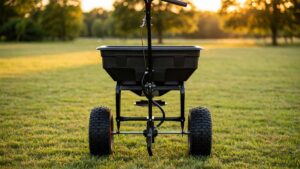
A large suburban yard changes what a spreader has to be. When the lawn runs to half an acre or more, a small hopper means a walk back to the garage every few passes, and hard plastic wheels judder across every bump, throwing the spread pattern off line. The best rotary lawn spreaders with pneumatic wheels for large suburban yards solve both problems at once: hoppers of 80 to 100 lb that hold a full bag and more, and air-filled tires that roll over rough turf with a steady, cushioned gait so the spinner plate below keeps an even speed and an even throw.
Every spreader in this guide was verified on an opened page — an Amazon listing for each model, backed where the listings run thin by maker spec sheets and manuals. Two features were non-negotiable. The machine had to be a rotary (broadcast) spreader, spinning material outward in a fan rather than dropping it in a band, and it had to ride on pneumatic wheels, stated by the maker rather than implied by a photograph. Beyond those gates, we favoured the things that matter at scale: enclosed gearboxes that keep grit out of the drive, pattern controls and deflectors for working along beds and drives, and frames and hoppers that shrug off fertilizer, which is corrosive stuff to leave sitting in a shed.
Capacity deserves one honest note. An 80 lb hopper and a 100 lb hopper both sound generous, and both are — but a full 100 lb load is a heavy push on soft or sloped ground even on good tires. Many experienced users fill partway on rough yards and top up on the flat. The pneumatic wheels in this group, from 12 in up to 14 in, are exactly what makes that load manageable, because air tires flex over roots, stones and frozen ruts instead of bouncing the hopper and spilling its rhythm.
Quick verdict
The Spyker ERGO-PRO SPY80-1P is the precision pick: the most accurate calibration dial in the group, an adjustable handle that fits almost any operator, and a lifetime gear warranty. The Lesco 101186 is the professional's high-wheel classic, with stainless running gear and a deflector kit for edging. The Buyers 3039632R is the width pick, throwing up to 24 ft from a 100 lb hopper, and it doubles as a winter salt spreader. The Chapin 8400C brings a stainless frame and the biggest tires here at 14 in, while the Chapin 8304C offers the same 100 lb class in a contractor build for less money. The Smith SB80 is the all-season value, with interchangeable shutoffs for summer and winter work.
Comparison table
| Product | Key spec | Best for |
|---|---|---|
| Spyker ERGO-PRO SPY80-1P | 80 lb hopper, 13 x 5 in pneumatic tires, AccuWay control | Accurate, even patterns on prized lawns |
| Lesco High Wheel 101186 | 80 lb hopper, 5:1 enclosed gearbox, manual deflector | Pro-style edging and rough, tall turf |
| Buyers Products 3039632R | 100 lb hopper, 13 in pneumatic tires, up to 24 ft throw | The widest passes and winter salt duty |
| Chapin 8400C SureSpread | 100 lb hopper, 14 in pneumatic tires, stainless frame | Corrosion resistance and the smoothest ride |
| Chapin 8304C Contractor Turf | 100 lb hopper, 12 in pneumatic wide-tread tires | Contractor capacity on a keener budget |
| Smith SB80 | 80 lb hopper, pneumatic tires, twin shutoffs | Year-round use, lawn in summer and ice in winter |
How we chose
The gates came first. Rotary action was verified from each maker's description of a spinner-driven broadcast pattern, and pneumatic wheels had to be stated in words — several well-known spreaders were set aside because their listings described rubber or all-terrain wheels without ever saying the tires are air-filled, and a hard wheel is a different tool on rough ground. Capacity came next: for large suburban yards we set the floor at 80 lb, because anything smaller turns a half-acre feed into a relay of refills.
After the gates, we weighed the hardware that decides how a spreader ages. Fertilizer dust and granules attack bearings and gears, so enclosed gearboxes scored heavily, and grease fittings scored more. Pattern control mattered too: a big yard is usually edged by beds, paths and a drive, and a spreader that cannot rein in its throw on one side will feed the flower beds and scorch stripes along the path. Deflectors, side controls and accurate rate dials all earned their place. Finally, the human fit was weighed — handle shapes and heights, machine weight, and whether the maker supports the tool with a real warranty — because a spreader this size is a decade-long purchase, not a season's experiment.
The picks in detail
Spyker ERGO-PRO SPY80-1P
- Hopper: 80 lb poly, bridge-free geometry that flows to empty
- Wheels: 13 x 5 in pneumatic tires
- Pattern: AccuWay control with Spyker Dial, spread width 4 to 12 ft
- Drive: fully enclosed metal gears with zerk fittings, lifetime gear warranty per the maker
- Handle: welded, adjusts for operators from 5 ft 3 in to 6 ft 6 in
- Weight: 43 lb; fitted cover and full deflector included
The ERGO-PRO is the engineer's spreader. Its hopper is shaped so material cannot bridge across the outlet and starve the spinner — the maker says it flows to empty without the shaking and bouncing that upset the rate on lesser machines — and the AccuWay system balances the pattern left to right while the Spyker Dial sets the rate with a fineness the other dials here do not match. The handle is the thoughtful part for a household tool: it adjusts across a wide range of operator heights, so the person pushing is not stooped or stretched. Enclosed metal gears with grease fittings and a lifetime gear warranty from the maker underline that this is built as a long-term instrument. Its 80 lb hopper is the joint-smallest here, which is the honest trade for its accuracy.
Pros: most precise calibration in the group; bridge-free hopper keeps flow steady; adjustable handle suits almost anyone; enclosed greasable gears with lifetime gear warranty.
Cons: 80 lb capacity means one more refill than the 100 lb models on the biggest yards; priced like the professional tool it is.
Lesco High Wheel Fertilizer Spreader 101186
- Hopper: 80 lb capacity
- Wheels: oversized pneumatic tires on a high-wheel chassis
- Drive: enclosed gearbox with 5:1 gear ratio
- Frame: stainless steel frame, axle and impeller shaft
- Pattern: manual deflector kit included
- Lineage: replaces the long-running Lesco 091186
The Lesco 101186 is the spreader lawn-care crews have pushed for years, and its design explains itself the first time you take it across tall or rough turf: the high wheels carry the hopper over ground that would bog a low machine down, and the oversized pneumatic tires keep the ride level. Stainless steel in the frame, axle and impeller shaft is aimed squarely at fertilizer corrosion, and the enclosed 5:1 gearbox drives the spinner with a measured, unhurried turn that suits an even pattern. The manual deflector kit is the detail suburban users will reach for most, narrowing the throw along beds and drives so product lands on grass, not on the plantings. The listing is light on tire dimensions and some assembly is required, but as a durable, professional-grade machine for a big yard it has few peers.
Pros: high-wheel design rolls through tall and uneven turf; stainless running gear resists fertilizer corrosion; deflector kit for clean edges; proven professional design.
Cons: listing leaves some specs unstated; assembly required; 80 lb hopper is mid-pack for capacity.
Buyers Products 3039632R 100 lb All-Season Walk-Behind Broadcast Spreader
- Hopper: 100 lb rust-resistant poly hopper
- Wheels: 13 in pneumatic tires
- Pattern: up to 24 ft spread with adjustable poly deflectors
- Drive: axle-powered spinner, enclosed gearbox with grease fitting
- Frame: fully welded, powder-coated carbon steel
- Extras: hopper screen and nylon rain cover included
If the yard is measured in long straight passes, this is the machine that shortens the day. A throw of up to 24 ft — roughly double the Spyker's maximum width — means fewer laps of a big lawn, and the adjustable deflectors pull the pattern back in when you run alongside the drive or the street. The 100 lb poly hopper will not dent or rust, the spinner is powered straight off the axle through an enclosed gearbox with a grease fitting, and the welded steel frame feels built for being hauled in and out of a truck bed. Buyers also rates it for bagged salt and ice melt in winter, which makes it a genuine two-season tool. The width that makes it fast in the open makes it the least delicate near beds, so detail work calls for the deflectors and a slower pass.
Pros: widest throw in the group at up to 24 ft; full 100 lb capacity; doubles as a winter salt and ice melt spreader; screen and rain cover included.
Cons: wide pattern needs managing near beds and paths; steel frame, though powder-coated, wants a rinse after fertilizer use.
Chapin 8400C Professional SureSpread 100 lb
- Hopper: 100 lb one-piece poly, weather and rust resistant
- Wheels: 14 in pneumatic tires — the largest here
- Frame: stainless steel frame and linkage
- Drive: enclosed gearbox with grease fitting
- Pattern: adjustable rotary gate with spread pattern control
- Warranty: 5-year limited warranty; made in the USA
The 8400C is the corrosion fighter of the group. Its hopper sits on a stainless steel frame with stainless linkage, its gearbox is enclosed and fitted with a grease point, and it rolls on 14 in pneumatic tires — the biggest in this line-up, and the ones that ride softest over acreage, ruts and rough pasture edges. The rotary gate adjusts the flow and the pattern control keeps the throw honest, while the T-handle with rubber grips is easy to hold with gloves on. Chapin backs it with a 5-year limited warranty and US-based support. One boundary to respect: the maker says plainly that this spreader is not recommended for salt products, sand or lime, so it is a turf machine pure and simple — seed, fertilizer and weed control products are its diet.
Pros: largest tires and smoothest rough-ground ride; stainless frame and linkage; enclosed greasable gearbox; strong warranty and US support.
Cons: not rated for salt, sand or lime, so no winter duty; premium pricing; assembly required.
Chapin 8304C Contractor Turf Broadcast Spreader 100 lb
- Hopper: 100 lb weather-proof poly hopper
- Wheels: 12 in pneumatic wide-tread tires
- Frame: powder-coated steel
- Drive: enclosed acetal gear system
- Pattern: solid steel gate linkage, adjustable rotary gate, spread pattern control
- Extras: zinc-plated agitator; rain/snow cover and grate included; 5-year limited warranty
The 8304C is the 8400C's working sibling: the same 100 lb class and the same 5-year limited warranty, built to a contractor brief at a keener price. The differences are in the materials — a powder-coated steel frame instead of stainless, an enclosed acetal gear system, and 12 in wide-tread pneumatic tires that grip well and track straight. A zinc-plated agitator stirs the load to break up clumps before they reach the gate, which matters with fertilizer that has sat in a damp garage, and the solid steel gate linkage has a direct, positive feel. It shares the family restriction on sand and lime mixes. For a large suburban yard that wants contractor capacity without the stainless premium, this is the value route into the 100 lb class.
Pros: full 100 lb capacity at a lower price than the stainless model; clump-breaking agitator; cover and grate included; 5-year limited warranty.
Cons: powder-coated frame needs more care than stainless; 12 in tires ride a touch firmer than the 14 in set; not for sand or lime mixes.
Smith SB80 80 lb Broadcast Spreader
- Hopper: 80 lb capacity
- Wheels: pneumatic tires, stated in the listing
- Pattern: wide broadcast pattern with adjustable flow control
- Agitator: spider agitator breaks up material to reduce clogging
- Seasonal: two interchangeable shutoffs for summer and winter applications
- Linkage: solid rod linkage; powder-coated frame
The Smith SB80 is the quiet all-rounder. Its party trick is a pair of interchangeable shutoffs — one for summer lawn products, one for winter salt and ice melt — so the same machine feeds the lawn in May and keeps the drive clear in January without a gate that is wrong for one of the two jobs. The spider agitator works the load as you push, breaking up the lumps that cause skips in the pattern, and the adjustable flow control is straightforward to set. Solid rod linkage gives the gate a positive action, and the pneumatic tires keep the whole thing composed on uneven ground. The listing is thinner on dimensions and warranty detail than the Chapin and Spyker pages, so buyers who like paperwork should note that; as a working tool, it covers the suburban brief well.
Pros: genuine two-season design with swappable shutoffs; agitator reduces clogging and skips; simple, positive controls; 80 lb capacity suits most suburban yards.
Cons: listing states fewer dimensions and warranty details than rivals; brand support network is smaller than Chapin or Spyker.
Buying guide
Match hopper size to the yard, honestly. A full bag of fertilizer is usually 40 to 50 lb. An 80 lb hopper swallows one bag with room to spare and suits lawns up to roughly half an acre per fill at typical rates; a 100 lb hopper doubles the bag count and suits the largest suburban plots. Bigger is not automatically better — a full 100 lb load on soft ground is a workout — but refills cost time and break your walking rhythm, which is where uneven applications creep in.
Tyre diameter is ride quality. All six here are pneumatic, but diameter still matters. The 14 in tires on the Chapin 8400C roll over obstacles with the least disturbance, the 13 in sets on the Spyker and Buyers are close behind, and the 12 in wide-treads on the 8304C trade a little softness for grip and tracking. Keep tires at the pressure the maker lists: a soft tire drags and wanders, an over-hard one bounces and shakes the pattern.
Pattern control is what separates tools from toys. On a big open lawn any broadcast spreader looks good. The test comes at the edges — beds, drives, paths and the street. Deflectors (Lesco, Buyers), side controls and balanced-pattern systems like Spyker's AccuWay keep product on the grass and off everything else. If your yard is mostly edges, weight this feature heavily; if it is mostly open acreage, weight throw width instead.
Enclosed gears and a rinse decide lifespan. Fertilizer is hygroscopic and corrosive; left in a hopper it cakes, and left on gears it eats them. Enclosed gearboxes — every model here has one — keep the grit out, and grease fittings (Spyker, Buyers, Chapin 8400C) let you service what remains. Whatever you buy, empty it after use, rinse the hopper and spinner, let it dry, and store it dry. Five minutes of care is the difference between a spreader that lasts three seasons and one that lasts fifteen.
Calibrate before the first real pass. Rate dials are starting points, not gospel, because granule size varies between products. The careful method: weigh out a known amount, spread a measured area, weigh what is left, and adjust. It takes ten minutes and it is the only way the number on the bag matches the number on your lawn. The Spyker's dial is the most refined here for this work, but the method matters more than the machine.
Salt is a separate decision. If winter spreading is part of the plan, choose a model the maker rates for it — the Buyers 3039632R and the Smith SB80 with its winter shutoff — and keep it rinsed, because salt is harder on steel than fertilizer. If winter is not part of the plan, the Chapins' turf-only focus and stainless or coated hardware may serve you better.
FAQ
What is the difference between a rotary spreader and a drop spreader?
A rotary (broadcast) spreader spins a plate that throws granules outward in a wide fan, covering ground quickly with some overlap between passes. A drop spreader releases product straight down between its wheels in a precise band. For large suburban yards the rotary design is the practical choice: it is faster, and its overlaps forgive small steering errors. Drop spreaders suit small, intricate lawns where every granule must land inside a line.
How wide a spread pattern do I need?
Most of the machines here throw between 4 and 12 ft depending on setting and material; the Buyers reaches up to 24 ft. Wider is faster on open ground and harder to control at edges. A good working approach is a mid setting for the open lawn and the deflectors or side control for the boundary passes, rather than running maximum width everywhere.
Do pneumatic tires really make a difference?
Yes, and the difference grows with yard size and roughness. Air-filled tires flex over stones, roots and ruts, which keeps the hopper level and the spinner speed steady, and a steady spinner is an even pattern. Hard wheels bounce, and every bounce shows up as a stripe. Pneumatics do need occasional pressure checks and can puncture, which is the trade.
How do I stop fertilizer burning stripes into the lawn?
Stripes usually come from overlaps doubling the rate, or from a wandering pattern. Walk at a steady pace, keep consistent pass spacing — many users halve the rate and make two passes at right angles for the most even result — and calibrate the gate for the actual product in the hopper. Shut the gate before you stop or turn at the headland, because a stationary spreader with an open gate dumps a pile.
Can I use the same spreader for seed and fertilizer?
Yes — all six here handle both, plus most granular weed control products. Seed is lighter and flows differently from fertilizer prills, so recalibrate the dial when you change material, and note the makers' exclusions: the Chapin models are not recommended for sand or lime, and pelletised lime is heavy enough to strain lighter gates.
How should I store the spreader between uses?
Empty, rinsed and dry. Tip out every granule, wash the hopper, spinner and gate, let the machine dry fully, and store it under cover with the gate closed. A light wipe of oil on exposed steel linkage, where the maker allows it, keeps the gate action smooth. Check tire pressures at the start of each season.
Conclusion
For large suburban yards, the winning formula is a big hopper, air-filled tires and a pattern you can control at the edges. The Spyker ERGO-PRO SPY80-1P is the accuracy pick, with the finest calibration and a handle that fits anyone. The Lesco 101186 brings professional high-wheel durability and a proper deflector kit. The Buyers 3039632R throws the widest pattern and works winters too. The two Chapins split the 100 lb class between stainless refinement (8400C) and contractor value (8304C), and the Smith SB80 covers both seasons with the least fuss. Choose by your yard's shape — edges, acreage or winter duty — and any of the six will turn a long chore into a steady walk.
Write Your Review
No reviews yet. Be the first to share your experience!