
Key takeaways
- The five genuine drop spreaders on pneumatic wheels, verified on opened pages, compared on hopper size, spread width and wheel design for uneven bumpy yards.
As an Amazon Associate I earn from qualifying purchases. This post may contain affiliate links at no extra cost to you.
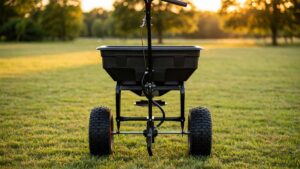
A drop spreader earns its place on rough ground in a way a broadcast spreader never has to: the machine meters material straight down through openings in the hopper floor, so every bounce, tilt and rut shows up in the application pattern. On an uneven, bumpy yard the wheels are not a comfort feature — they are the suspension, the ride height and half the accuracy of the machine. That is why the best drop fertilizer spreaders with pneumatic wheels for uneven bumpy yards form such a short list: air-filled tires are the one wheel type that can absorb a bump instead of transmitting it to the hopper, and very few drop spreaders are built on them.
This article states the situation plainly at the start, because it shapes everything that follows. Across this whole program's research — dozens of drop spreader listings opened and read — exactly five models pair a genuine drop mechanism with genuinely pneumatic wheels. The same five have appeared in sibling articles in this program under different angles, and they appear here again with that repetition disclosed rather than disguised, because inventing a sixth model or quietly swapping in a solid-wheeled machine would mislead the reader. What changes in this article is the lens: each machine is judged on how its wheels, hopper and frame behave when the ground will not sit still.
The five are the SaltDogg WB400 and the Spyker P70-12010 as walk-behind machines, the two Gandy Turf Tender widths, 36H13 and 24H13, and the Agri-Fab 45-0288 as the tow-behind option. Every specification below comes from an opened page — the makers' Amazon listings and the Gandy retailer's product page — and maker wording is reported as maker wording throughout.
Quick verdict
For a walk-behind machine on rough ground, the SaltDogg WB400 is the most direct answer: its maker states outright that the 13-inch pneumatic tires provide stability on uneven surfaces, and the stainless frame and 200 lb hopper suit a big, lumpy property. The Spyker P70-12010 is the precision pick, splitting its 36-inch width into two 18-inch sections that can run independently. The Gandy 36H13 and 24H13 are the turf-trade machines, built around stainless bottoms and a tri-bar rotor, in wide and narrow formats. The Agri-Fab 45-0288 is the choice when the bumpy ground is measured in acres and a tractor is doing the pulling.
| Product | Key spec | Best for |
|---|---|---|
| SaltDogg WB400 | 200 lb hopper, 13-in pneumatic tires | Walk-behind work on rough ground |
| Spyker P70-12010 | Twin 18-in sections, 120 lb hopper | Precision passes and section control |
| Gandy Turf Tender 36H13 | 36-in width, stainless snap-off bottom | Wide, even coverage on turf |
| Gandy Turf Tender 24H13 | 24-in width, about 78 lb capacity | Narrow gates and smaller rough lawns |
| Agri-Fab 45-0288 | 175 lb hopper, 42-in width, tow-behind | Acreage covered from a tractor seat |
How we chose
The gate for this keyword has two halves, and both were applied strictly. First, the machine must be a true drop spreader: material falls by gravity through a shuttered hopper floor across a fixed width, rather than being flung by a spinning plate. Second, the wheels must be pneumatic — air-filled tires — as stated on an opened page, not inferred from a photograph. Solid wheels, never-flat foam wheels, flat-free tires and semi-pneumatic wheels all failed the gate, however good the spreader attached to them. That is why familiar names are missing here: the Scotts Classic Drop rides on solid wheels, several budget drop spreaders ride on never-flat tires, and one Agri-Fab spiker-seeder variant rides on flat-free tires. Those exclusions are recorded in the sources file.
Within the gate, only five models exist in current program evidence, and this article presents all five with the repetition across sibling articles disclosed openly. Specs come from the opened pages: the Amazon listings for the SaltDogg, Spyker and Agri-Fab, and the Gandy retailer's page for the two Turf Tenders, supplemented for the Gandy machines by maker catalog figures recorded in earlier program research and identified as such in the sources file. No prices appear in this article; the keyword carries no price band, and drop spreaders at this level are trade-priced machines in any case.
The products
Buyers Products SaltDogg WB400 Walk Behind Drop Spreader (B003TSJYTI)
- Hopper: 2.5 cu ft poly, up to 200 lb of bagged material
- Spread width: 44 inches, the widest walk-behind path here
- Wheels: 13-inch pneumatic tires
- Frame: stainless steel frame, agitator and trough
- Flow control: solid linkage lever, with hopper screen and rain cover included
- Assembly: arrives 90% assembled per the maker
- Weight: 67 lb listed
- Origin and cover: made in USA; 1-year warranty per the maker
The WB400 is the only machine in this set whose maker argues the uneven-ground case in its own words: the listing states that the large 13-inch pneumatic tires provide premium stability on uneven surfaces. That sentence matters because it is the design intent, not a reviewer inference — the tire is there to keep a 200 lb hopper composed when the ground is not. The low-to-the-ground drop design keeps material falling where the pass intends, and the stainless trough and agitator resist the corrosion that fertilizer salts work on lesser metals.
The hopper screen earns a mention for bumpy yards specifically: a screen breaks up clumps before they reach the openings, and clumps are what turn a bounce into a blocked shutter and a bare stripe. The solid linkage lever lets the operator fine-tune the discharge rate, and the rain cover keeps stored material dry between sessions. At 44 inches it covers a full path in one pass, which reduces the number of passes — and therefore the number of bump crossings — a rough lawn demands. The honest cautions are its weight and its heritage: 67 lb before material goes in, and the machine's design roots are in salt and ice-melt work, so an owner spreading fine seed should confirm the rate settings suit the material.
Pros:
- Maker explicitly rates the pneumatic tires for uneven surfaces
- Largest walk-behind hopper and widest path in the set
- Stainless frame, agitator and trough for corrosion resistance
- Hopper screen and rain cover included
Cons:
- 67 lb before any material is loaded
- Design heritage is salt and ice melt; fine-seed rates need checking
- Premium trade pricing tier for the category
Spyker P70-12010 Pro-Series Side-by-Side Drop Spreader (B00YMTFO24)
- Hopper: 120 lb capacity, all-steel construction
- Spread width: 36 inches total, as two 18-inch side-by-side sections
- Wheels: 13 x 5 inch pneumatic turf-tread tires per the maker's specification material
- Frame: powder-coated steel
- Bottom plates: two interchangeable steel bottom plates per the maker's one-sheet
- Weight: 65 lb listed
The Spyker's defining idea is sectional control. The 36-inch width is built as two 18-inch drop sections sitting side by side, and the sections can be run together or independently. On an uneven yard that matters in a practical way: a pass along a fence line, a tree ring or a bumpy border strip can run at half width with the outer section shut, keeping material off paths and beds while the machine still tracks the full width of its own wheels. No other machine in this set offers that.
The 13 x 5 inch wheels are the widest-section tires here, and width is its own form of bump management: a broad pneumatic tire bridges small hollows instead of dropping into them, which steadies the hopper floor and therefore the drop pattern. The all-steel hopper and powder-coated frame are commercial-grade choices, and the interchangeable steel bottom plates let the opening pattern change with the material. At 65 lb it is a serious machine to push before loading, and its 120 lb hopper is mid-sized for this set, so it trades the SaltDogg's bulk capacity for control. For a homeowner whose bumpy yard is also a patterned yard — beds, borders, tight returns — that trade is the point of the machine.
Pros:
- Two independent 18-inch sections for half-width passes
- Wide 13 x 5 inch pneumatic tires bridge small hollows
- All-steel hopper with interchangeable bottom plates
- Commercial build throughout
Cons:
- 65 lb unladen weight
- Hopper capacity is mid-set at 120 lb
- Section controls add setup steps a simpler machine avoids
Gandy Turf Tender 36H13 Variable Rate Drop Spreader
- Spread width: 36 inches
- Wheels: 13-inch pneumatic wheels, per the Gandy retailer's page
- Bottom: stainless steel slide; stainless snap-off bottom per maker catalog figures in program research
- Rotor: tri-bar rotor for consistent agitation, per the retailer page
- Capacity: about 1.8 cu ft, roughly 120 lb, per maker catalog figures in program research
- Openings: 30, per maker catalog figures in program research
- Shutoff: positive shutoff with a rate chart, per maker catalog figures
Gandy builds for the turf trade, and the 36H13 shows it in the details a homeowner notices only after a season: the stainless bottom slide is there because fertilizer salts corrode ordinary steel, and the retailer page states that purpose directly. The tri-bar rotor keeps material agitated as the machine rolls, which is the quiet half of bump management — a pneumatic tire smooths the ride, but the rotor is what keeps the flow even while the hopper is still moving over rough ground.
The 13-inch pneumatic wheels match the largest walk-behind fitments in this set. Thirty openings across 36 inches give a fine-grained drop pattern, and the variable-rate design with its rate chart suits owners who switch between seed and fertilizer and want a documented setting for each rather than a guess. The cautions are about sourcing and support rather than the machine: Gandy sells through turf-equipment channels rather than mass retail, the listing route is a specialist retailer, and some figures here come from maker catalog material recorded in program research rather than a consumer product page, which the sources file identifies line by line.
Pros:
- Stainless slide and bottom built for corrosive materials
- Tri-bar rotor supports even flow over rough ground
- 13-inch pneumatic wheels
- Documented rate settings for repeatable applications
Cons:
- Sold through turf-trade channels, not mass retail
- Fewer consumer-facing specifications published
- Trade-tier pricing and parts route
Gandy Turf Tender 24H13 Variable Rate Drop Spreader
- Spread width: 24 inches, the narrowest in this set
- Wheels: 13-inch pneumatic wheels, per the Gandy retailer's page
- Bottom: stainless steel slide; stainless snap-off bottom per maker catalog figures in program research
- Rotor: tri-bar rotor, per the retailer page
- Capacity: about 1.2 cu ft, roughly 78 lb, per maker catalog figures in program research
- Openings: 20, per maker catalog figures in program research
- Shutoff: positive shutoff with a rate chart, per maker catalog figures
The 24H13 is the same Gandy design at gate width. Twenty-four inches passes through the garden gates, side-yard gaps and shed doors that stop a 36 or 44-inch machine, and on a small, bumpy lawn the narrower hopper carries less material weight over the bumps, which keeps the machine easier to hold on line when a wheel drops into a hollow. It keeps the features that define the line: the stainless slide and snap-off bottom, the tri-bar rotor, the positive shutoff and the 13-inch pneumatic wheels shared with its wider sibling.
Capacity is the honest cost: at roughly 78 lb of material it will need refilling on anything beyond a modest lawn, and the 20 openings across 24 inches still give a fine pattern but cover ground at two-thirds the rate of the 36-inch model. This is the pick for the owner whose rough ground comes in small, fenced pieces — a terraced back garden, a bumpy side lawn, strips between beds — where the wide machines physically cannot go and a broadcast spreader would throw material onto every path and border.
Pros:
- Narrowest width here for gates and fenced sections
- Same stainless bottom and tri-bar rotor as the 36H13
- 13-inch pneumatic wheels despite the small frame
- Lighter material load to manage over bumps
Cons:
- Smallest capacity in the set at roughly 78 lb
- Slowest coverage rate of the five
- Specialist retail channel, as with its sibling
Agri-Fab 45-0288 Tow-Behind Drop Spreader (B000KL1L6Q)
- Hopper: 175 lb, 17-gallon rustproof poly hopper
- Spread width: 42 inches, controlled drop pattern
- Coverage: approximately 40,000 sq ft per fill per the maker
- Wheels: pneumatic tires, stated in the listing's own specification block (12 x 3.5 inch per program research on this listing)
- Agitator: galvanized steel
- Control: on/off control reachable from the tractor seat; universal hitch
- Origin: built in Sullivan, Illinois, USA with global materials, per the maker
The Agri-Fab answers a different version of the bumpy-yard problem: when the rough ground is an acre of it, the walking is the hardship, and the machine should ride behind a lawn tractor instead. The pneumatic tires matter just as much in tow service, because a towed hopper has no operator's hands absorbing shocks through the handles — every bump travels through the hitch and frame into the hopper, and air-filled tires are the only cushion in that chain. The listing's specification block states the pneumatic tire type directly.
The 42-inch controlled width and roughly 40,000 sq ft coverage per fill make it the volume machine of this set, and the rustproof poly hopper with a galvanized agitator is a sensible material pairing for fertilizer. The on/off control from the tractor seat is the feature that protects borders and driveways: the operator can shut the flow at the headland without dismounting. The cautions follow from the format — it needs a tractor with a hitch, it cannot work a fenced strip the tractor cannot reach, and a towed machine's pattern depends on a steady towing speed over the bumps, which the operator controls with the throttle rather than with their stride.
Pros:
- Largest coverage per fill in the set
- Pneumatic tires cushion a hopper with no operator damping
- Seat-reachable flow control protects borders
- Rustproof poly hopper, galvanized agitator
Cons:
- Requires a lawn or garden tractor
- Cannot reach ground the tractor cannot reach
- Pattern depends on steady towing speed over rough patches
Buying guide
Wheel diameter and tire construction decide more on bumpy ground than any other specification in this category. A pneumatic tire deforms around a stone or a rut edge and recovers; a solid or foam-filled wheel transmits the same event straight into the hopper as a jolt, and a jolt at the wrong moment is a surge or a gap in the drop pattern. Diameter helps independently of construction: a 13-inch wheel rolls over a bump that stops a small wheel against its face. Every machine in this set runs 12 to 13-inch pneumatic fitments, which is precisely why the set is so short.
Match the width to the ground's furniture, not its area. Wide machines — 42 and 44 inches — cover open rough acreage fastest but cannot pass a standard garden gate, and on a bumpy lawn divided by beds and paths, the narrower Gandy and the sectional Spyker waste less material and less effort. Section control, the Spyker's twin 18-inch drops, is worth singling out for yards with borders: half-width passes along edges are the difference between fertilizing the lawn and fertilizing the path.
Materials decide the machine's lifespan with fertilizer. Stainless bottoms and slides, as on both Gandys and the SaltDogg, resist the salts that pit plain steel; poly hoppers, as on the SaltDogg and Agri-Fab, do not corrode at all but should be checked for flex under full loads. Agitation matters on rough ground too: a rotor or agitator that keeps material moving, like Gandy's tri-bar design, resists the bridging that bumps and vibration otherwise encourage in a half-full hopper.
Finally, be honest about format. A walk-behind machine gives the operator's body as part of the suspension and works anywhere a person can walk; a tow-behind covers acreage but only where the tractor can go, at the speed the tractor can hold steady. On genuinely uneven ground, slower and steadier beats fast on either format — the drop pattern is laid at the speed the wheels cross the bumps.
FAQ
Why are there only five models in this roundup?
Because the gate is strict and the market is narrow. A machine must be a true drop spreader and must ride on pneumatic tires as stated on an opened page. Many well-known drop spreaders ride on solid, never-flat or flat-free wheels, and they were excluded on that point alone, with the exclusions recorded in the research notes. Rather than pad the list with machines that fail the keyword, the article presents the complete genuine set and says so.
Do pneumatic tires really change the application pattern?
Yes, through ride quality. A drop spreader lays material at a rate set by its ground-driven mechanism and shutter opening. When a solid wheel hits a bump, the hopper jolts and the flow surges or stalls for a moment; an air-filled tire absorbs much of that event. The SaltDogg's maker states the stability benefit for uneven surfaces in its own listing copy.
Can these machines spread grass seed as well as fertilizer?
Drop spreaders as a class handle both, and the variable-rate Gandys publish rate settings intended for repeatable applications across materials. Fine seed flows differently from granular fertilizer, so the setting for one is not the setting for the other; the rate chart or the maker's guidance for the specific material is the authority, and the SaltDogg's design heritage in salt and ice melt makes that check especially worthwhile there.
Walk-behind or tow-behind for a bumpy acre?
If the acre is open and a lawn tractor is already in the shed, the Agri-Fab covers it with the least walking and the largest hopper. If the acre is fenced, terraced or planted with beds, the walk-behind machines reach all of it and the sectional Spyker protects the borders. Ground shape, not size alone, should decide.
How do I keep a drop pattern even on a slope?
Work across the slope rather than up and down it where the ground allows, keep a steady pace, and overlap passes slightly at the edges, since a drop spreader's width is exact and leaves no feathered margin. A half-width machine like the Spyker run in sections can also let the operator work a steep strip separately at a slower, steadier pace.
Conclusion
Uneven, bumpy ground is the hardest test a drop spreader faces, and it is a test of wheels before anything else. The five machines here are the complete set that pairs a true drop mechanism with pneumatic tires in current listings: the SaltDogg WB400 for walk-behind capacity with the maker's own uneven-surface case, the Spyker P70-12010 for sectional precision, the two Gandy Turf Tenders for trade-grade stainless construction in wide and narrow widths, and the Agri-Fab 45-0288 for towed acreage. The list is short because the gate is honest — and on rough ground, a short list of machines that genuinely fit is worth more than a long one that does not.
Write Your Review
No reviews yet. Be the first to share your experience!