
Key takeaways
- Five battery-powered handheld spreaders compared for seeding a new lawn, with hopper sizes, flow settings, spread widths and coverage figures the makers list.
As an Amazon Associate I earn from qualifying purchases. This post may contain affiliate links at no extra cost to you.
Seeding a new lawn is the one spreading job where the equipment genuinely changes the result. Grass seed is light, the rates are low, and a freshly prepared seedbed is soft: drag a heavy wheeled spreader across it and the wheels carve tracks, push seed into rows and compact the soil the seed needs to sit in. That is why the best battery-powered lawn spreaders for newly seeded lawns are handhelds. A battery handheld puts a spinning disc under a small hopper, throws a short, controlled pattern, and lets the operator walk the seedbed at a steady pace while metering flow with a dial rather than a squeeze-and-guess hand crank.
Every battery-powered lawn spreader sold on Amazon US is a handheld — there is no walk-behind battery spreader class in the US market, a point this program verified when the sibling keyword for large suburban yards could not be filled. For a newly seeded lawn that limitation is actually the right shape. The five spreaders below hold between roughly two and five litres of seed, throw patterns from five feet to a maker-stated sixteen feet, and offer between six and twenty-three flow settings. On new seed, the settings at the fine end of the dial are the ones that matter, and each of these makers publishes a fine-seed range.
The other discipline on a new lawn is traffic. Seed needs contact with soil and then to be left alone, so the spreading plan should cover the area in as few, as even passes as possible. A spreader with an edge deflector keeps seed out of beds and off paths, an anti-clog agitator keeps fine seed flowing instead of pulsing, and a battery that outlasts the job keeps the pace — and therefore the rate — consistent from the first pass to the last.
Quick verdict
The WORX WG869 is the most complete seeding tool here: it pairs six disc speeds with eight flow settings, adds an anti-clog agitator and an edge-control deflector, and the maker maps its lowest flow levels to fine seed. The Scotts Wizz is the precision pick, with twenty-three settings and EdgeGuard control on a five-foot broadcast, ideal for small new lawns and patch seeding. The Craftsman V20 Four Season carries the biggest hopper of the branded handhelds at 1.2 gallons and suits owners already holding V20 batteries. The WORKPRO 7.2V is the self-contained value pick, with a built-in rechargeable battery, two hours of stated runtime and six seeding angles. The GEARWAVE set is the runtime pick: two included 20V batteries, a 3.3 litre hopper and the widest stated throw here.
Comparison table
| Product | Key spec | Best for |
|---|---|---|
| WORX WG869 20V Cordless Broadcast Spreader | 6 speeds, 8 flow settings, edge deflector, anti-clog agitator | Even seeding with edge control |
| Scotts Wizz Hand-Held Spreader (71131) | 23 settings, EdgeGuard, 5 ft broadcast, 4 AA batteries | Small new lawns and patch work |
| Craftsman V20 Four Season Spreader (CMCOE300B) | 1.2 gal hopper, 6 speeds, up to 5,000 sq ft per tub | V20 battery owners, bigger seed jobs |
| WORKPRO 7.2V Cordless Spreader (WX125302AE) | 2.5 L hopper, 8 levels, 6 seeding angles, USB charging | Buyers wanting one self-contained unit |
| GEARWAVE Handheld Seed Spreader | 3.3 L hopper, two 20V batteries included, 16 ft stated spread width | Long sessions without a battery swap stop |
How we chose
Products were verified on Amazon product pages opened during this research, and the specs quoted are the makers' own listing figures. The screen for this keyword had four parts. First, the spreader had to be battery powered and sold as a lawn spreader for seed — vehicle-mount 12V broadcast units for ATVs and mower decks were excluded, because towing or mounting one defeats the point on a soft seedbed. Second, the maker had to publish flow control fine enough for grass seed; every pick here lists a fine-seed setting range. Third, the hopper and stated coverage had to suit residential new lawns, from patch seeding up to a full renovation of a few thousand square feet per fill. Fourth, the model had to clear the program's recall screen; none of these handheld spreaders appears on it.
One honest note on coverage figures: makers rate coverage per fill using their own lawn products and settings, so the numbers are comparable only as a rough guide. What transfers reliably to seeding work is the combination of hopper size, the number of flow settings, and whether the maker provides an edge control — those are the facts this article leans on.
WORX WG869 20V Cordless Broadcast Spreader
- Power: WORX 20V Power Share battery, included in this listing
- Coverage: up to 4,600 sq ft per load, maker-stated
- Spread distance: up to 5 ft
- Controls: 6 disc speeds and 8 flow-rate settings
- Features: anti-clog agitator, edge-control deflector
- Weight: 3.1 lb
The WG869 reads like it was specified by someone who has seeded a lawn. The flow baffle has eight settings, and the maker maps them by material: levels 1–2 for fine seeds, 3–4 for light fertilizer, rising to 7–8 for pearled fertilizer and ice melt. For new seed, that means the working range sits at the bottom of the dial with steps still in reserve, rather than at a single cracked-open notch. Disc speed is separately adjustable across six speeds, and because throw distance follows disc speed, the operator can narrow the pattern for a small seedbed or widen it on an open one without changing the flow setting.
Two features do quiet but important work. The anti-clog agitator keeps fine seed moving through the gate, which is what stops the pulsing — heavy, light, heavy — that leaves stripes in a new lawn. The edge-control deflector keeps seed in bounds along driveways, paths and bed edges, where seed would otherwise be wasted and later mowed as an odd green fringe in the mulch. At 3.1 lb it is light enough for one-handed use across a long session, and the battery is part of the WORX Power Share platform, which the maker lists as covering more than 140 tools.
Pros:
- Eight flow settings with a maker-mapped fine-seed range
- Anti-clog agitator supports an even rate on fine seed
- Edge deflector keeps seed off paths and out of beds
Cons:
- Five-foot maximum throw means more passes on open ground
- Coverage per load is mid-pack at 4,600 sq ft
Scotts Wizz Hand-Held Spreader (71131)
- Power: 4 AA batteries
- Settings: 23 flow settings
- Broadcast: 5 ft with EdgeGuard Technology
- Capacity: holds up to 2,500 sq ft of Scotts lawn products
- Use: grass seed, fertilizer and weed control products, maker-stated
The Wizz is the precision instrument of this group. Twenty-three settings is more flow resolution than any other spreader here, and on a newly seeded lawn that granularity is the whole game: seed rates are specified tightly, and the difference between settings is where an even stand comes from. The maker describes it as the most advanced spreader in its line, and the design centres on control rather than capacity — a five-foot broadcast, with EdgeGuard Technology to hold the pattern off edges with the flip of a control.
Power comes from four AA batteries, which cuts both ways. There is no charger to manage and no platform battery to buy, and a fresh set of AAs is available anywhere; but there is also no fuel gauge worth the name, and a long renovation day is a job for carrying spares. The hopper holds enough product for up to 2,500 square feet of Scotts lawn products per the maker's rating, which sizes it honestly: this is the spreader for a small new lawn, a re-seeded section, or the careful overseeding pass, rather than a full-size renovation done in one fill. For those jobs, its combination of fine settings and edge control is the best here.
Pros:
- Twenty-three settings give the finest rate control here
- EdgeGuard keeps seed on the seedbed and off hard surfaces
- AA power needs no charger or platform battery
Cons:
- Smallest effective capacity in the group
- AA batteries need spares on hand for long sessions
Craftsman V20 Four Season Spreader (CMCOE300B)
- Power: Craftsman V20 battery platform, tool only in this listing
- Hopper: 1.2 gallons
- Coverage: up to 5,000 sq ft per tub, maker-stated
- Controls: 6 speed settings, 36 spreader combinations
- Warranty: 3 year limited, maker-stated
The Craftsman entry is the capacity pick among the branded handhelds. Its 1.2 gallon tub is the largest hopper in this article, and the maker rates it at up to 5,000 square feet distributed per tub. On a new lawn of any real size, fewer refills mean fewer chances to lose track of where the last pass ended — the overlap errors that show up weeks later as dark and pale stripes. Six speed settings combine with the flow gate for what the maker counts as thirty-six distribution combinations, and the listing states an adjustable swath, so the pattern can be pulled in for narrow seeded strips between beds.
The catch is in the listing title: tool only. The value of this spreader depends entirely on whether a V20 battery and charger already live in the garage. For an owner with V20 tools, it is the obvious buy — the biggest tub, a three-year limited warranty as listed, and a platform battery that will outlast several fills. For an owner without one, the battery and charger purchase belongs in the comparison, and the WORX or GEARWAVE sets, which include their batteries, start ahead. The Four Season name reflects the maker's year-round pitch across seed, fertilizer and salt; for this article only the seeding case matters, and there it is sound.
Pros:
- Largest hopper here at 1.2 gallons
- Up to 5,000 sq ft per tub means fewer refill stops
- Strong fit for owners already on the V20 platform
Cons:
- Sold as tool only; battery and charger are separate
- Six speeds is fewer than the WORX offers
WORKPRO 7.2V Cordless Spreader (WX125302AE)
- Power: built-in 7.2V rechargeable battery, USB charging cable included
- Hopper: 2.5 litres
- Runtime: up to 2 hours on a full charge, maker-stated
- Controls: 8 level settings, 6 speeds from 900 to 2,200 rpm, 6 seeding angles to 127 degrees
- Coverage: up to 6,458 sq ft for grass seed, maker-stated
- Weight: 3.52 lb
The WORKPRO takes the opposite approach to the platform tools: everything is in the box. The battery is built in and charges by USB, the stated runtime is up to two hours, and there is nothing else to buy. Its control set is the most elaborate here. Eight level settings are mapped by the maker with levels 1–3 for fine grass seed, and the throwing angle itself adjusts through six seeding angles up to 127 degrees — a control none of the others list, and a useful one on a seedbed, because angling the throw changes how gently seed lands and how wide a single pass covers.
The maker's coverage figure for grass seed, up to 6,458 square feet, is the highest stated here, though as noted in How we chose, such figures follow each maker's own test product and should be read as approximate. The 2.5 litre hopper is mid-sized. Two cautions come straight from the listing: the unit is not waterproof, so it wants a dry cloth rather than a hose-down after use, and the maker warns against forcing the throw-width lever if seed lodges under the dispersion wheel — clear the seed first, then reset. Neither point is a problem for careful seeding work, and the all-in-one format makes this the easiest recommendation for a one-off renovation.
Pros:
- Fully self-contained: battery built in, USB charging
- Six seeding angles add pattern control the others lack
- Fine-seed range mapped across levels 1–3
Cons:
- Not waterproof; cleaning is dry-cloth only
- Built-in battery cannot be swapped mid-job
GEARWAVE Handheld Seed Spreader
- Power: two 20V 2,000 mAh lithium-ion batteries included
- Hopper: 3.3 litres
- Coverage: up to 8,600 sq ft with a 16 ft spread width, maker-stated
- Controls: 6 speeds from 900 to 2,200 rpm, 8 level settings
- Weight: 5.29 lb
The GEARWAVE set is built around not stopping. Two 20V batteries come in the box, so a flat battery is a ten-second swap rather than the end of the session — and on a seedbed, an unplanned stop mid-pass is exactly how overlaps and missed strips happen. The 3.3 litre hopper is the second largest here, and the maker's stated coverage, up to 8,600 square feet with a sixteen-foot spread width, is the widest claim in the group. That throw should be read carefully for seeding: a wide pattern at a fine flow setting is hard to keep even, and most operators will dial the speed down and work a narrower pattern on new seed, reading the headline width as a fertilizer figure.
The control mapping mirrors the WORKPRO pattern: eight levels with levels 1–2 for fine grass seeds, and six speeds spanning 900 to 2,200 rpm. At 5.29 lb it is the heaviest handheld here, the honest price of the bigger hopper and full-size battery format. The brand is a marketplace name rather than a tool-platform name, so long-term battery availability is a fair question; the two included batteries soften it. For a big renovation done in a day, where runtime and refill stops are the binding constraints, this is the set that removes them.
Pros:
- Two batteries included for unbroken sessions
- 3.3 L hopper and the widest stated coverage here
- Fine-seed levels stated by the maker
Cons:
- Heaviest here at 5.29 lb
- Sixteen-foot throw is too wide for fine seeding at full speed
Buying guide
Match the spreader to the size of the seeding job first. For patch seeding and small new lawns up to a couple of thousand square feet, the Scotts Wizz and its twenty-three settings give the finest control, and its small hopper is no handicap. For a full renovation, hopper size and battery endurance take over: the Craftsman tub, the GEARWAVE's twin batteries and the WORKPRO's two-hour runtime all reduce the stops that cause uneven passes.
Second, look at how the maker handles fine seed specifically. Grass seed bridges and clogs more readily than fertilizer prills, so an anti-clog agitator (WORX) or a maker-mapped fine-seed setting range (WORX, WORKPRO, GEARWAVE) is worth more than a long feature list aimed at salt and ice melt. Edge control matters just as much: seed thrown onto a path or into a bed is wasted, and both the WORX deflector and Scotts EdgeGuard exist to stop it.
Third, decide the battery question before comparing anything else. Platform owners get the best value from their own system — V20 owners from the Craftsman, Power Share owners from the WORX, which in this listing includes its battery. Everyone else should compare complete sets: the WORKPRO with its built-in battery, or the GEARWAVE with two included. A tool-only price is not the price of a working spreader.
Finally, plan the passes, not just the purchase. On a new lawn, apply half the seed in one direction and half at right angles to it, keep a steady walking pace, and overlap patterns lightly at the edges. A spreader with more settings helps only if the operator picks the maker's fine-seed range and holds the pace the rate assumes.
FAQ
Why not use a wheeled broadcast spreader on a new lawn?
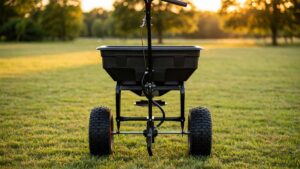
On a prepared seedbed the soil is loose, and wheels cut tracks, push seed sideways into lines and compact the surface. A handheld battery spreader keeps all weight off the bed except the operator's footprints, and its short throw suits the low rates grass seed needs. On an established lawn the wheeled machine is fine; on a new one the handheld is the gentler tool.
Is there a walk-behind battery spreader for bigger new lawns?
No — the battery spreader market on Amazon US is handhelds plus 12V vehicle-mount units for ATVs and mower decks, which this program verified while researching the sibling keyword for large suburban yards. For a big new lawn, the practical answer is a large-hopper handheld such as the Craftsman or GEARWAVE and a planned refill routine, or a conventional wheeled spreader used before final grading rather than after.
Which settings should I use for grass seed?
Start where the maker tells you to. The WORX maps fine seed to flow levels 1–2 of 8, the WORKPRO to levels 1–3 of 8, and the GEARWAVE to levels 1–2 of 8. The Scotts Wizz offers twenty-three settings and Scotts publishes rates for its own seed products. Whichever spreader you choose, begin at the fine end and check the throw on a path or tarp before walking the seedbed.
How do I keep the seeding rate even from start to finish?
Hold a constant walking pace, because the rate per square foot is flow divided by pace. Keep the hopper reasonably full so the gate feeds consistently, use the edge control along boundaries instead of feathering the trigger, and split the seed into two half-rate passes at right angles. A battery that lasts the whole job — or a spare, as in the GEARWAVE set — removes the pace change that comes with a dying motor.
Can these spreaders also apply starter fertilizer?
Yes. Every maker here lists fertilizer among the intended materials, and the mid-range flow settings are mapped to it — the WORX, for example, places light fertilizer at levels 3–4. Apply starter fertilizer in a separate pass from the seed so each rate can be set on its own, and clean the hopper afterwards, since fertilizer residue is corrosive and the WORKPRO listing, for one, specifies dry cleaning only.
Conclusion
For newly seeded lawns, the battery handheld is not a compromise — it is the correct tool, light on the seedbed and precise at low rates. The WORX WG869 is the best all-round seeding spreader here, with its agitator, edge deflector and maker-mapped fine-seed settings. The Scotts Wizz wins on pure rate resolution for smaller jobs, the Craftsman V20 on hopper size for platform owners, the WORKPRO on self-contained convenience, and the GEARWAVE on unbroken runtime. Pick by the size of your seeding job and the batteries already in your garage, set the dial to the maker's fine-seed range, and walk it evenly.
Write Your Review
No reviews yet. Be the first to share your experience!