
Key takeaways
- Five rotary broadcast spreaders under 100 compared for steep sloping lawns, with hopper sizes, pneumatic tire types and edge control as each maker lists them.
As an Amazon Associate I earn from qualifying purchases. This post may contain affiliate links at no extra cost to you.
Spreading seed or fertilizer on a slope is a different job from spreading on flat ground. The spreader wants to drift downhill, product rolls further on the downhill side than it does uphill, and a hopper that felt light on the flat can pull hard against your hands once the lawn tilts. The right best rotary lawn spreaders under 100 for steep sloping lawns answer those problems with grip, balance and edge control rather than raw capacity, and every model in this roundup stays inside the under 100 band on its product page.
The five picks below are all walk-behind rotary broadcast spreaders, the spinning-disc design that throws product in a fan pattern as you walk. Two come from Scotts, the long-running name in home lawn care, and both carry the maker's EdgeGuard side shield, which matters more on a slope than almost any other feature because it lets you shut off the downhill throw along paths, beds and retaining walls. The other three are larger framed machines with pneumatic tires, the kind of wheel that bites into turf instead of skating across it, and hoppers big enough to finish a banked lawn without walking back uphill for a refill.
Prices move, so the band evidence for each model sits in the research notes rather than in this article. What follows concentrates on the figures each maker lists: hopper capacity, tire size and type, spread width, flow settings and frame construction, plus the handling traits that decide whether a spreader behaves itself on a gradient.
Quick verdict
For most sloping lawns, the Scotts Turf Builder EdgeGuard DLX is the easiest recommendation: it arrives pre-calibrated, holds enough product for up to 15,000 square feet of coverage per fill, and its EdgeGuard shield gives clean control along the edges where slope work usually goes wrong. Smaller or steeper patches suit the EdgeGuard Mini, which holds product for up to 5,000 square feet and folds its handle down for storage. If your slope is long and refills mean a climb, the Toolsempire 66 lb pairs the biggest hopper here with 13-inch pneumatic tires. The VEVOR 60 lb is the lightest of the framed machines and assembles without tools, while the MAXSA 70 lb brings a carbon steel frame and all-terrain tires at a mid-pack weight.
Comparison table
| Product | Key spec | Best for |
|---|---|---|
| Scotts Turf Builder EdgeGuard DLX | Holds product for up to 15,000 sq ft; EdgeGuard side shield | Edge control on medium sloping lawns |
| Scotts Turf Builder EdgeGuard Mini | Holds product for up to 5,000 sq ft; fold-down handle | Small, steep patches and terraces |
| Toolsempire 66 lb Walk-Behind | 66 lb hopper; 13-in pneumatic tires; 30-level dial | Long slopes with few refills |
| VEVOR 60 lb TC2135 | 60 lb hopper; 18 settings; 8-in pneumatic tires | Lighter framed spreading on mixed ground |
| MAXSA 70 lb Walk-Behind | 70 lb hopper; 8-in all-terrain pneumatic tires | Big fills on rough, uneven slopes |
How we chose
Every product here was verified on its opened Amazon product page, and the specifications quoted come from those pages and nowhere else. The band gate came first: each spreader had to sit under the 100 mark on its page on the day of research. The second gate was design. Only rotary broadcast spreaders qualify, so drop spreaders, handheld shakers and tow-behind units were left out even when they were cheaper.
The third gate was slope suitability, judged on stated features rather than marketing claims. Pneumatic tires earned priority because an air-filled tire deforms against turf and holds a line across a gradient better than a hard plastic wheel. Edge control earned priority because product thrown downhill travels further, so a shield or deflector on the downhill side keeps granules off paths and out of beds. Hopper size was read two ways: a large hopper cuts refill trips on a long slope, but a smaller, lighter machine is easier to hold back on a short, steep one, so the set includes both ends of that trade. Flow adjustment range mattered as well, because walking speed changes on a slope and a fine dial lets you compensate.
Two Scotts models appear because the EdgeGuard shield is genuinely scarce in this price band; the remaining three places went to framed machines from Toolsempire, VEVOR and MAXSA, each with pneumatic tires and a distinct capacity point. No model here repeats a pick from the sibling drop spreader articles, which covered a different mechanism entirely.
Scotts Turf Builder EdgeGuard DLX Broadcast Spreader
- Capacity: holds up to 15,000 sq ft of Scotts lawn product per the maker
- Edge control: EdgeGuard Technology side shield
- Setup: pre-calibrated, no assembly required
- Feed: hopper and agitator designed for smooth product funneling
- Model: 76232; item weight 10.9 lb per the product page spec table
The DLX is the spreader most home lawn owners already know, and on a slope its party trick is the EdgeGuard shield. Flip the shield on and the disc stops throwing to one side, so walking the contour line above a driveway or a flower bed no longer means feeding the concrete. The maker lists the hopper as holding enough product for up to 15,000 square feet of coverage, which on a typical sloping suburban lawn means one fill for the whole job, and one fill matters when the alternative is carrying a bag back up the bank.
It also arrives pre-calibrated with no assembly, and at 10.9 lb before product it is light enough to carry to the top of the slope and work downward. The hopper and agitator are designed for smooth funneling, per the maker, which helps keep the flow even when your walking pace slows on the climb. The trade-off is wheel size: the DLX rolls on smaller wheels than the framed machines below, so on very rough or rutted slopes it asks more of the operator.
Pros: EdgeGuard shield for downhill edge control; pre-calibrated with no assembly; light to carry uphill; large coverage per fill for its size
Cons: Smaller wheels than the pneumatic-tired models; capacity figure is stated in coverage area rather than pounds; best suited to Scotts-style granular products
Scotts Turf Builder EdgeGuard Mini Broadcast Spreader
- Capacity: holds up to 5,000 sq ft of Scotts lawn product per the maker
- Edge control: EdgeGuard Technology side shield
- Setup: pre-calibrated, no assembly required
- Storage: fold-down handle
- Model: 76121
The Mini is the DLX idea shrunk for small, steep ground: terraces, side banks, the narrow strip between a fence and a retaining wall. It holds enough product for up to 5,000 square feet per fill, and that smaller load is a handling advantage on a gradient, because a half-size hopper pulls far less against your grip when you turn across the slope. The EdgeGuard shield is present here too, which is unusual at this size, and it makes the Mini a tidy tool for edging along the paths that usually border steep lawn sections.
The maker lists it as pre-calibrated and ready to use, with a fold-down handle for storage in a crowded shed. The same hopper and agitator arrangement as its bigger sibling is designed to funnel product smoothly. What you give up is coverage per fill and wheel presence: this is a machine for patches and banks, not for a half-acre hillside, and refills on a long slope will mean trips back to the bag.
Pros: EdgeGuard shield in a compact frame; light load is easier to control on steep turns; fold-down handle stores easily; no assembly or calibration
Cons: 5,000 sq ft coverage means frequent refills on larger slopes; small wheels on rough ground; sized for smaller lawns by design
Toolsempire 66 lb Walk-Behind Broadcast Spreader
- Capacity: 66 lb hopper
- Tires: 13-in pneumatic all-terrain tires
- Flow control: lever with 30-level adjustable dial; 3-hole drop system
- Spread width: 0 to 6.5 ft per the maker
- Frame: metal frame, fully enclosed gearbox, PP hopper; item weight 23.5 lb
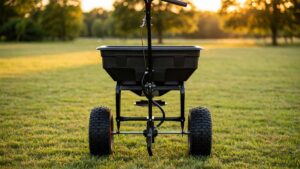
The Toolsempire is the heavy lifter of this set. Its 66 lb hopper is the largest here, and on a long slope that translates directly into fewer climbs back to the garage. The maker lists 13-inch pneumatic tires, the biggest wheels in this roundup, and describes them as giving strong traction and balance on grass, gravel and muddy patches, which is exactly the footing a loaded spreader needs when the ground tilts and the surface is damp.
Flow control is a lever with a 30-level dial working a 3-hole drop system, so you can fine-tune output as your pace changes between the uphill push and the downhill hold-back, and a hopper screen helps limit clogging from compacted granules. The spread width is listed at up to 6.5 feet, narrower than a big contractor machine but well matched to contour passes. The enclosed gearbox and metal frame suggest a machine built to be kept, though at 23.5 lb empty it is the one you will feel most on the carry up.
Pros: Largest hopper here means fewest refills; 13-in pneumatic tires for slope traction; fine 30-level flow adjustment; enclosed gearbox and metal frame
Cons: Heaviest empty weight in the set; narrower spread width than contractor models; large frame stores less easily
VEVOR 60 lb Walk-Behind Broadcast Spreader TC2135
- Capacity: 60 lb hopper
- Tires: 8-in pneumatic tires
- Flow control: 18 adjustable settings with disc pellet controller
- Frame: powder-coated steel frame; plastic hopper
- Setup: tool-free assembly; item weight 16.53 lb; model TC2135
The VEVOR TC2135 sits in the middle of this set on almost every figure, and that is its appeal. The 60 lb hopper is close to the Toolsempire's capacity, yet the machine weighs 16.53 lb, the lightest of the three framed spreaders, so it is the one to look at if the slope work starts with a carry. The maker lists 18 adjustable settings with a disc pellet controller for rate control, and 8-inch pneumatic tires that the listing describes as suited to grass, gravel and snow.
Assembly needs no tools per the maker, which also means it comes apart more readily for storage. The powder-coated steel frame and impact-resistant hopper are listed as resisting UV and corrosion. On a slope, the smaller 8-inch tires will not roll over ruts and tufts as calmly as the Toolsempire's 13-inch pair, and there is no edge shield, so downhill edging relies on your line and pace rather than a mechanical shut-off.
Pros: Light for a 60 lb framed spreader; tool-free assembly; 18 rate settings; powder-coated frame
Cons: 8-in tires are less calm on rough slopes than 13-in tires; no edge shield for downhill borders; plastic hopper rather than metal
MAXSA 70 lb Walk-Behind Broadcast Spreader
- Capacity: 70 lb hopper
- Tires: 8-in all-terrain pneumatic tires
- Frame: reinforced carbon steel frame with rust-resistant powder coating
- Hopper: UV-resistant hopper per the maker
- Flow: adjustable flow settings; ergonomic handle
The MAXSA lists the largest nominal capacity in this roundup at 70 lb, in a frame the maker describes as reinforced carbon steel with a rust-resistant powder coating. Its 8-inch all-terrain pneumatic tires are listed as rolling smoothly over rough ground, and the listing specifically mentions uneven lawns, which is the polite term for the ground most slope owners actually have. Adjustable flow settings handle rate changes, and the ergonomic handle and balanced design are listed as making pushing easier on large properties.
That balance point matters on a gradient: a spreader whose weight sits over the axle rather than ahead of it is far easier to hold on a downhill traverse. The MAXSA gives up the fine dial granularity of the Toolsempire and the edge shield of the Scotts pair, and its 70 lb rating is a hopper figure rather than a coverage figure, so compare it against the others on that basis.
Pros: Biggest hopper rating here; carbon steel frame with powder coating; all-terrain pneumatic tires; balanced design for slope traverses
Cons: No edge shield; flow settings less granular than the 30-level dial rival; capacity stated in pounds only
Buying guide
Start with the slope itself. On a short, steep bank, weight is the enemy twice over: the loaded hopper drags downhill on every turn, and you carry the machine up before you start. A compact spreader like the EdgeGuard Mini, filled partway, is easier to hold on a line than a full-size machine filled to the brim. On a long, gentler slope the arithmetic reverses, and hopper capacity wins, because every refill is a walk back uphill with a bag. Match the machine to the refill trip you least want to make.
Tires come next. Pneumatic tires are the single most useful slope feature in this price band: the air-filled casing flexes against turf, keeps contact on uneven ground and resists the sideways skid that hard wheels start on damp grass. Bigger diameters roll over tufts, ruts and edging stones with less jolt, and a jolt is not just uncomfortable, it dumps a pulse of extra product. If your slope is smooth and closely mown, wheel size matters less; if it is rough pasture-style ground, it matters more than any other line in the spec table.
Edge control deserves its own thought. On flat ground a broadcast spreader throwing onto a path is a sweeping job. On a slope, product thrown downhill lands further out and rolls, and granules that reach a driveway wash into drains at the next rain. A side shield such as EdgeGuard, which blocks the throw on one side, is the cleanest answer. Without one, work the border passes with the downhill side as your outer edge and reduce the rate, accepting a lighter band you can correct with a second pass at a lower setting.
Flow settings are your pace compensation. Nobody walks a constant speed on a slope: you push uphill and restrain downhill. A spreader calibrated at one walking speed over-applies when you slow and under-applies when you stride out. A fine dial, such as the 30-level control on the Toolsempire, or a wide range of settings like the VEVOR's 18, lets you open the gate slightly for the climb and close it for the descent. Whatever model you choose, do a short calibration pass on the flattest ground you have, measure what actually came out, and write the setting on the hopper with a marker.
Technique ties it together. Work across the slope in contour passes rather than straight up and down it: traversing keeps the spreader level, keeps the throw pattern even, and keeps your footing side-on rather than leaning into the hill. Overlap each pass by roughly a quarter of the spread width, keep the hopper no more than two-thirds full on steep sections so the load stays manageable, and save the border pass for last with the shield on or the rate reduced. Rinse the hopper and disc after use, since fertilizer residue corrodes, and let the machine dry before it goes back in the shed.
Finally, read capacity figures carefully because makers state them differently. Scotts rates its spreaders by coverage area, the square feet a full hopper of its own product covers, while Toolsempire, VEVOR and MAXSA rate theirs in pounds of product. A 70 lb hopper and a 15,000 square foot rating are not directly comparable numbers; what matters for slope work is how many refills your lawn will demand, and that depends on your product's application rate as much as on the hopper.
FAQ
Is a rotary broadcast spreader or a drop spreader better on a slope?
For most sloping lawns the rotary broadcast design is the easier tool: it is lighter, it covers ground faster, and its throw can be shielded on the downhill side. A drop spreader places product more precisely between its wheels, but it is heavier to hold on a traverse and slower across a large bank. This roundup covers rotary models only, as the keyword asks.
How do I stop fertilizer rolling downhill after spreading?
Granules roll when they land on hard, dry, closely mown turf. Spreading when the grass is slightly damp helps granules lodge in the sward, and watering lightly afterwards, where the product label allows it, settles them further. The bigger fix is at the machine: keep the throw off hard surfaces with an edge shield and avoid over-applying on the downhill passes by closing the gate a step.
What tire type should I choose for a sloping lawn?
The makers here list pneumatic tires on all three framed models, and that is the type to prefer: air-filled tires grip turf, absorb jolts that would otherwise pulse the flow, and track straighter across a gradient. Larger diameters, such as the 13-inch pair on the Toolsempire, handle rough ground more calmly than 8-inch tires.
Should I walk up and down the slope or across it?
Across it, in contour passes. Traversing keeps the spreader level so the disc throws an even fan, and it is steadier footing for the operator. Walk the border next to paths and beds last, with the edge shield engaged or the rate reduced, because product thrown downhill travels furthest.
How full should the hopper be on steep ground?
Partly full is easier to control. A two-thirds fill keeps enough product aboard for several passes while keeping the downhill drag manageable on turns. On gentle slopes with long runs, fill fully and enjoy the fewer refills; the framed models here carry 60 to 70 lb for exactly that case.
Do these spreaders handle salt and ice melt as well as fertilizer?
The makers of all five models list winter use with salt or ice melt among their applications, and the Scotts pair is listed for year-round use including ice melt. Rinse the hopper, disc and gate thoroughly after salt work, because salt residue is hard on metal parts and on the rate mechanism.
Conclusion
Slope spreading rewards control over capacity, and the five machines here split that trade in useful ways. The Scotts EdgeGuard DLX remains the default pick for its shield and its no-assembly setup, the Mini covers small steep patches with the same edge control, and the Toolsempire, VEVOR and MAXSA bring pneumatic tires and 60 to 70 lb hoppers to longer banks, at weights from about 16.5 to 23.5 lb. Pick by the refill trip and the roughest ground on your lawn, calibrate on the flat, and work the contour lines: a rotary spreader under 100, chosen on its stated tires, shield and flow range, will cover a sloping lawn evenly without feeding the driveway.
Write Your Review
No reviews yet. Be the first to share your experience!