
Key takeaways
- Five battery-powered spreaders verified on opened pages for uneven bumpy yards, with hopper sizes, throw widths and flow controls as stated by their makers.
As an Amazon Associate I earn from qualifying purchases. This post may contain affiliate links at no extra cost to you.
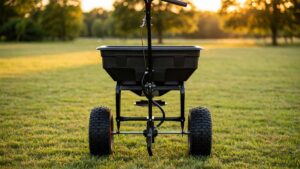
Uneven ground is the quiet enemy of even spreading. A wheeled spreader crossing a bumpy yard speeds up and slows down as it climbs and drops, and a gravity-fed gate pays out more material on every jolt, so the lawn ends up striped: heavy where the wheels bounced, thin where they rolled smooth. Battery power changes the equation, because the disc speed comes from a motor rather than from the wheels, and the smallest battery spreaders are carried rather than rolled at all, which takes the bumps out of the mechanism entirely. This guide gathers the best battery-powered lawn spreaders for uneven bumpy yards verified on opened pages, and it is frank about the shape of this market before it names a single product.
The frank part first, because earlier research in this program established it beyond doubt: there is no walk-behind battery spreader class of the push-cart kind on Amazon US. The battery spreader market is handhelds with hoppers of a few litres, one chest-carried unit, and exactly one wheeled walk-behind exception, the Einhell in this list. That market shape turns out to suit bumpy yards better than the missing cart would. A spreader carried in the hand or on the chest does not care whether the ground beneath it is level, because its disc turns at the speed the motor sets while the operator walks at whatever pace the terrain allows. The picks below are screened on that logic: motor-driven discs, stated flow control, and hopper sizes matched to yards where refills happen on rough ground, far from the garage.
Quick verdict
The Einhell GE-SR 18/22 Li is the one genuine walk-behind here, a 22-litre wheeled machine whose electronically controlled application speed is the closest thing in this market to an answer for pace changes over bumps. The Hooyman 24V chest spreader carries 35 lb of material on a harness and throws up to 20 feet, removing wheels from the problem entirely. The GEARWAVE handheld is the value pick with two batteries in the box and a stated 16-foot spread width. The Ryobi OSS1800 brings the largest handheld hopper at 4 litres and an anti-clog agitator, while the Uniqwamo unit for Milwaukee 18V batteries is the lightest verified option at 2.81 lb.
| Product | Key spec | Best for |
|---|---|---|
| Einhell GE-SR 18/22 Li | 22L hopper; wheeled; spread up to 6 m | Larger bumpy yards that still want a walk-behind |
| Hooyman 24V Chest Spreader | 35 lb capacity; up to 20 ft throw; harness | Rough ground where wheels are the problem |
| GEARWAVE Handheld 20V | 3.3L; 16 ft spread width; two batteries included | Handheld coverage on a budget |
| Ryobi OSS1800 18V ONE+ | 4L / 5kg hopper; anti-clog agitator | Ryobi owners who refill least often |
| Uniqwamo for Milwaukee 18V | 3L; 2.81 lb; 125-degree disc opening | The lightest carry over the roughest patches |
How we chose
The gate was a battery-driven broadcast disc verified on an opened page, with the flow and speed controls the maker states. That gate sounds simple, but it shapes the whole list, because the push-cart spreader most buyers picture does not exist in battery form in this market; the verified classes are handheld, chest-carried and one wheeled walk-behind. Each class was then read against the keyword's terrain. Carried spreaders were credited for what they are: machines whose application rate cannot be disturbed by a bump, because nothing about their mechanism touches the ground. The wheeled Einhell was judged on its stated electronic controls, which hold the application speed the operator sets instead of tying output to wheel speed.
Hopper size was weighed against refill reality. On an uneven yard, every refill is a walk back over the same rough ground carrying an open bag, so the stated capacities — from 3 litres to 22 litres, plus the Hooyman's 35 lb — are listed per product with their battery arrangements, including which listings are bare tools. Throw width and disc angle are quoted exactly as the makers state them, in the makers' own units, and coverage claims are reported as maker claims rather than findings. Four of these five models have appeared in earlier spreader articles in this program under other angles; the repeats are disclosed in the sources file, and the uneven-terrain reading here is new for each of them.
The products
Einhell GE-SR 18/22 Li Battery Powered Spreader
- Hopper: 22 litres, the largest in this group
- Format: wheeled walk-behind, the only one verified in this market
- Spread width: adjustable up to 6 m as listed
- Controls: variable flow rate and electronically controlled application speed
- Battery: 18V Power X-Change, sold separately — this listing is the bare tool
- Use: fertiliser, grass seed, salt and grit per the maker
The Einhell is the exception that proves the market rule, and it earns its place on the strength of one stated feature: the application speed can be set and controlled electronically. On a bumpy yard, that is the control that matters, because it holds the rate the operator chose while the wheels climb and drop instead of letting ground speed dictate output. The maker pairs it with an adjustable spreading rate and a spread width that can be narrowed or widened up to 6 metres, so a rough paddock-style lawn can be covered in wide passes and a narrow bumpy strip can be reined in. The 22-litre hopper is in a different league from the handhelds — roughly seven times the smallest here — which turns refills from a rhythm of the job into an occasional pause.
The costs are format and battery. It is still a wheeled machine, so on genuinely rough ground the operator is pushing a loaded cart over the same bumps, and its gate, however well controlled, rides on wheels that jolt. The listing is for the spreader body only: the 18V Power X-Change battery and charger are sold separately, which is painless for an owner inside that platform — the maker lists compatibility across more than 300 tools — and an added purchase for everyone else. For a larger uneven yard, though, nothing else verified here comes close on capacity.
Pros: Only verified walk-behind battery spreader; 22L hopper dwarfs the handheld class; electronically controlled application speed suits uneven pace; width adjustable up to 6 m.
Cons: Bare tool, battery and charger extra; wheeled format still crosses the bumps it manages; heaviest commitment for a small yard.
Hooyman 24V Lithium-Ion Chest Spreader
- Capacity: 35 lb as listed
- Throw: up to 20 feet per the maker
- Runtime: up to 3 hours continuous per the maker
- Controls: adjustable feed rate; ergonomic handle trigger
- Carry: detachable t-slot shoulder harness system
- Battery: 24V battery and charger included; limited lifetime warranty as listed
The Hooyman answers uneven ground by leaving it. Worn on the chest with the maker's detachable harness, it throws material up to 20 feet — the longest stated throw in this group — while the operator simply walks the bumps at walking pace. The 35 lb capacity is the largest load here by weight, and the stated runtime of up to 3 hours is aimed at long sessions across big, rough areas such as the food plots the maker also names. The feed rate adjusts, and the maker describes the trigger as offering an even flow with an anti-clog action, which is the carried equivalent of pace control: the disc and gate answer to the hand, not to the terrain.
The honest limits are load and aim. Thirty-five pounds carried on the chest is a serious weight by the end of a large yard, and the harness distributes rather than removes it. A chest spreader's pattern also depends on the operator's walking line and swing in a way a wheeled machine's does not, so the evenness the keyword wants is partly a skill. One figure in the maker's own copy conflicts — a bullet weight and a spec-table weight disagree — so no unit weight is stated in this article; the conflict is recorded in the sources file.
Pros: No wheels to bounce; longest stated throw at up to 20 feet; biggest load at 35 lb; battery included with long stated runtime.
Cons: Heavy load carried on the body; evenness depends on operator technique; maker's own weight figures conflict, so none is quoted.
GEARWAVE Handheld Seed Spreader, 20V
- Hopper: 3.3 litres
- Batteries: two 20V 2,000 mAh batteries included
- Spread: up to 16-foot spread width and up to 8,600 sq ft coverage per the maker
- Controls: 6 speeds from 900 to 2,200 rpm; 8 flow levels banded by material
- Disc: maximum spread angle 125 degrees
- Weight: 5.29 lb as listed
The GEARWAVE is the handheld that tries hardest to behave like a bigger machine. Its stated 16-foot spread width is wide for a 3.3-litre handheld, and the maker bands its eight flow levels by material — the lowest pair for fine grass seed, the middle ranges for light and heavy fertiliser, the top pair for de-icer or soybean — which is genuinely useful on a bumpy yard, where the operator wants the setting chosen before the walk rather than adjusted mid-bounce. Two batteries in the box answer the runtime question that bare-tool listings leave open, and the six motor speeds run to 2,200 rpm.
The coverage figure of up to 8,600 sq ft is the maker's claim and reads generously against a 3.3-litre hopper; on real ground it means refills, and each refill is the walk this keyword makes awkward. At 5.29 lb before material, it is also the heaviest handheld here, roughly double the Uniqwamo, which tells on a long rough yard. Neither point disqualifies it: for a medium uneven yard, the combination of width, settings and included batteries is the strongest value case in the group.
Pros: Two batteries included; wide stated throw for a handheld; flow levels banded by material; six disc speeds.
Cons: Coverage claim outruns the 3.3L hopper, so refills are frequent; heaviest handheld in the group at 5.29 lb.
Ryobi OSS1800 18V ONE+ Spreader
- Hopper: 4 litres / 5 kg, the largest handheld hopper here
- Battery: 18V ONE+ bare tool, battery and charger not included
- Distribution: up to 2 metres per the maker's bullet points
- Controls: adjustable flow rate and spread pattern
- Agitator: integrated anti-clog agitator as listed
- Weight: 3.22 lb as listed in this program's earlier verification
The Ryobi is the refill-minimiser among the handhelds. A 4-litre, 5 kg hopper is a third larger than the 3-litre class, and on uneven ground that difference is measured in avoided trips: one fewer walk back to the bag for every few thousand square feet. The integrated anti-clog agitator matters on bumps for a subtler reason — material settles and bridges in a hopper that is being jostled, and an agitator keeps the flow to the gate steady between the operator's checks. Flow rate and spread pattern both adjust, and the maker states a distribution range of up to 2 metres in its bullet points, a modest, believable figure for a handheld.
That modesty cuts both ways: a 2-metre pattern means more walking passes than the GEARWAVE's stated width, and more passes on rough ground is more time on the bumps. The listing is a bare tool, so the price of entry depends entirely on whether the buyer already owns ONE+ batteries; for the millions who do, it is the natural pick, and for everyone else the battery purchase belongs in the comparison. An earlier article in this program noted that the listing's title and bullet figures for spread distance differ; this article uses the bullet figure and records the conflict in the sources file.
Pros: Largest handheld hopper at 4L / 5 kg; anti-clog agitator suits jostled material; adjustable flow and pattern; huge battery platform.
Cons: Bare tool; narrow stated distribution means more passes; listing's own spread figures conflict between title and bullets.
Uniqwamo Handheld Spreader for Milwaukee 18V
- Hopper: 3 litres
- Battery: tool only, for Milwaukee 18V batteries, not included
- Coverage: maximum 700 square metres per the maker
- Controls: 6 spreading speeds; 8 sowing-volume settings
- Disc: 125-degree adjustable opening
- Weight: 2.81 lb as listed, the lightest here
The Uniqwamo is the light-carry option for the roughest ground. At 2.81 lb before material and battery, it is the spreader a user can take across the parts of a yard where no wheeled machine should go — the rutted strip behind the shed, the banked corner, the patch the mower scalps. Its controls are complete for its size: six speeds, eight volume settings and a disc opening that adjusts through 125 degrees, so the pattern can be narrowed to a fan for a strip or opened for a lawn. The maker states a maximum coverage area of 700 square metres, which, like all coverage claims here, is the maker's own figure against a 3-litre hopper.
The platform lock is the obvious condition: it runs only on Milwaukee 18V batteries, which the listing does not include, so it is a pick for one workshop's owners and a non-starter for everyone else. The 3-litre hopper is the joint-smallest here, and the brand is a minor one, so the long-term parts and support picture is thinner than Ryobi's or Einhell's. Within its niche — an M18 owner with a bumpy yard — it is exactly shaped for the job.
Pros: Lightest verified spreader at 2.81 lb; full control set for its size; 125-degree adjustable disc opening; suits ground no cart can cross.
Cons: Milwaukee 18V only, battery not included; small 3L hopper; minor brand with a thinner support picture.
Buying guide
Match the format to the ground first. If the yard is uneven the way most lawns are uneven — dips, humps, a worn path, tree-root ridges — a carried spreader removes the problem rather than managing it, and the choice narrows to hopper size and battery platform. If the yard is large and merely bumpy rather than rough, the Einhell's 22-litre hopper and electronically held application speed repay its wheels, because the alternative is a dozen refills of a 3-litre handheld.
Second, count the battery honestly. Two of these five listings include batteries; three are bare tools whose real cost includes a battery and charger for anyone outside the platform. On uneven ground the platform question has a second edge: the spreader will be carried or pushed one-handed over rough footing, so a battery already owned, already charged and shared with the trimmer is worth more than a spec-sheet advantage. Third, read throw widths as the makers state them and no further. The figures here run from 2 metres to 20 feet, quoted in each maker's own units because the pages quote them that way; a wider throw covers a bumpy yard in fewer passes but throws a wider, thinner pattern that wind and slope can move, while a narrow pattern is slower and more controllable.
Fourth, think about the refill walk. Hopper capacity is the specification that decides how often the operator crosses the worst ground carrying an open bag. The spread from 3 litres to 22 litres, plus a 35 lb chest load, is the widest difference in this group, and on a genuinely uneven yard it can matter more than any control. Finally, use the flow bands: makers that band their settings by material — fine seed low, coarse fertiliser high — save the operator from recalibrating mid-yard, which is when bumpy-ground spreading usually goes wrong.
FAQ
Why is there no push-cart battery spreader in this list?
Because the class does not exist in the verified market. Earlier research in this program, reconfirmed here, found handhelds, one chest unit and the wheeled Einhell; push-cart spreaders on Amazon US are manual or 12V vehicle-mount units. The article works with the classes that actually verify rather than describing a product that cannot be bought.
Does a carried spreader really spread more evenly on bumps?
Its mechanism cannot be disturbed by the ground, because the disc speed comes from the motor and nothing rolls. The maker-stated controls — feed rate on the Hooyman, flow levels on the handhelds — then decide the rate. The operator's walking line still matters, which the product sections say plainly.
Which pick suits the largest uneven yard?
The Einhell, on capacity and control: a 22-litre hopper against 3 to 4 litres for the handhelds, and an application speed held electronically while the wheels cross rough ground. The Hooyman is the alternative where the ground is too rough for wheels at all.
Are the coverage figures reliable?
They are the makers' claims, reported as such. A stated 8,600 sq ft from a 3.3-litre hopper implies several refills, and the articles in this program read coverage numbers as claims to plan around, not measurements.
What if I already own tool batteries?
Then the bare tools become the value picks: the Ryobi for ONE+ owners, the Uniqwamo for Milwaukee 18V owners and the Einhell for Power X-Change owners. The platform match is stated per product so the comparison can be made on the battery already in the shed.
Conclusion
Uneven ground rewards the spreader that ignores it. For most bumpy yards that means a carried machine: the Hooyman where the ground is roughest and the yard is big, the Ryobi where refills are the enemy, the GEARWAVE where two included batteries and a wide throw settle the value question, and the Uniqwamo where the lightest carry wins. The Einhell stands apart as the one walk-behind that verifies, and its electronically held application speed makes it the considered pick for a large yard that is bumpy rather than wild. Choose by format first, battery second and hopper third, and the stripes that bumps usually write into a lawn stay unwritten.
Write Your Review
No reviews yet. Be the first to share your experience!