
Key takeaways
- Commercial broadcast spreaders with pneumatic wheels for uneven, bumpy yards: Buyers, John Deere and Chapin models with stated tire sizes and load capacities.
As an Amazon Associate I earn from qualifying purchases. This post may contain affiliate links at no extra cost to you.
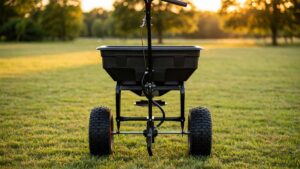
A broadcast spreader lives or dies by its wheels. On a flat, smooth lawn almost any wheel rolls well enough, but a bumpy yard — rutted, sloping in patches, crossed by tree roots and old drainage lines — punishes small solid wheels: they drop into every hollow, bounce the hopper, and shake the flow gate so the application rate wanders with every step. The best commercial broadcast spreaders with pneumatic wheels for uneven bumpy yards use air-filled tires that flex over that ground instead of fighting it, keeping the spinner plate level and the pattern even while the operator walks at a steady pace.
Every model in this roundup has pneumatic tires that its maker states plainly on the product page, in sizes from 10 to 13 inches. The sets used by this program's earlier spreader articles — for large suburban yards, newly seeded lawns, professional routes, spring renovation and steep slopes — are not repeated here; these five are different machines chosen for the same job on rougher ground. Capacities run from 60 to 100 pounds, and every specification quoted comes from a page opened during research.
Quick verdict
The Buyers Products 3039632R is the heavy-duty anchor of the set, with 13-inch pneumatic tires, a welded carbon steel frame and a spread pattern the maker rates up to 24 feet. The John Deere 60 lb spreader, built by Agri-Fab, is the lighter, simpler option with a cable flow control and a stated coverage of up to 11,000 square feet. Two unbranded 100 lb machines offer big hoppers with 10-inch and 12-inch pneumatic tires at the working end of the range, and the Chapin 88200A SaltPro brings an all-season design with baffles and a spiked auger for material that clumps.
Comparison table
| Product | Key spec | Best for |
|---|---|---|
| Buyers Products 3039632R 100 lb | 13-in pneumatic tires, pattern up to 24 ft | The roughest ground and widest patterns |
| John Deere 60 lb Push Broadcast Spreader | 10 x 3.5-in pneumatic tires, cable flow control | Smaller commercial yards and lighter loads |
| Unbranded 100 LB Walk-Behind Spreader | 10-in pneumatic tires, 12 ft width, 25 settings | Big hopper capacity on a steel frame |
| Unbranded 100LB Spreader, 30-Level Flow | 12-in pneumatic tires, 30-level flow control | Fine rate control across varied material |
| Chapin 88200A SaltPro 80 lb All-Season | 12-in pneumatic tires, 30 gate settings, baffles | All-season work including ice melt |
How we chose
The gate for this roundup was simple to state and strict in practice: the maker must list pneumatic tires on the product page. Several well-known spreaders were set aside because their pages describe the wheels only as rubber or all-terrain without saying they are air-filled, and on bumpy ground that distinction is the whole point of the keyword. Tire diameter also mattered — larger tires bridge ruts and roots better — so each entry below states the tire size its maker publishes.
The second filter was separation from earlier articles in this program. EarthWay, Spyker, Agri-Fab's own-label models, Lesco, Titan and the Chapin turf models have all been covered under other angles, so this set is built from different machines: a Buyers Products all-season model, the Agri-Fab-built John Deere, two unbranded high-capacity machines and Chapin's all-season SaltPro. Specs come only from opened pages, and prices were recorded in the research notes alone.
A spreader for bumpy ground also needs a frame and gearbox that tolerate vibration. Enclosed gearboxes, welded frames and hopper screens all appear in this set because rough yards shake loose material into clumps and shake open gates that are not positively controlled.
Buyers Products 3039632R 100 lb All-Season Walk-Behind Broadcast Spreader
- Capacity: 100 lb hopper
- Tires: 13-inch pneumatic
- Spread pattern: up to 24 ft, with adjustable poly deflectors
- Drive: axle-powered spinner disc, enclosed gearbox with grease fitting
- Frame: fully welded, powder-coated carbon steel
- Included: hopper screen and nylon rain cover
Buyers Products builds equipment for commercial users, and this spreader reads like it. The maker lists a rust-resistant poly hopper that will not dent, carried on a fully welded carbon steel frame with a powder-coated finish, rolling on 13-inch pneumatic tires — the largest in this roundup. On broken ground, that tire size is the difference between rolling over a rut and dropping into it, and the welded frame is built to take the twisting that uneven yards apply.
The spinner disc is powered from the axle, and the enclosed gearbox carries a grease fitting so the alloy gears can be serviced rather than simply sealed and forgotten. A simple flow lever and adjustable poly deflectors guide the pattern, which the maker rates at up to 24 feet — wide enough that fewer passes cross a big rough yard, and each pass is another chance for bumps to disturb the rate. The maker positions the machine for all-season work: grass seed and fertilizer in the growing months, bagged salt or ice melt in winter. A hopper screen promotes consistent flow, and a nylon rain cover is included.
Pros:
- Largest tires in the set at 13 inches for rough ground
- Welded carbon steel frame and serviceable enclosed gearbox
- Widest stated pattern, up to 24 feet
- Hopper screen and rain cover included
Cons:
- 100 lb capacity makes a full hopper heavy to push on soft ground
- Wide pattern needs care near beds and paths
- Commercial build is more machine than small yards require
John Deere 60 lb Push Broadcast Spreader
- Capacity: 60 lb poly hopper
- Tires: 10 x 3.5-inch pneumatic
- Coverage: up to 11,000 sq ft, as listed
- Flow control: cable system
- Handle: steel U-shaped push handle
- Build: made by Agri-Fab in Sullivan, Illinois, USA, with global materials, as listed
- Warranty: 2-year limited, as listed
The John Deere entry is the manageable one. Its 60 lb no-rust poly hopper holds enough for the maker-stated coverage of up to 11,000 square feet, and the machine arrives pre-assembled, which the listing highlights as a setup convenience. The flow is managed by a cable control system worked from a steel U-shaped handle, so the operator can open and close the gate without letting go of the push bar — a small thing that matters when the ground keeps both hands busy.
The tires are 10 x 3.5-inch pneumatic, the smallest in this set but still air-filled, and the listing credits them with smoother movement across lawn terrain. The maker describes the spreader as designed for seed, fertilizer, weed control products, rock salt and other lawn materials across the seasons. Buyers who found the 100 lb machines more than their yard needs will find this the proportionate choice, and the John Deere name comes with the dealer network that stands behind it.
Pros:
- Pre-assembled and ready to work
- Cable flow control operated from the handle
- Lighter 60 lb capacity suits smaller commercial yards
- Pneumatic tires in a compact, manageable machine
Cons:
- Smallest tires here, so the roughest ruts still register
- 60 lb hopper needs refills on larger properties
- Coverage figure is a maker estimate, not a measured rate
Unbranded 100 LB Walk-Behind Broadcast Spreader
- Capacity: 100 lb hopper
- Tires: 10-inch pneumatic
- Spread width: 12 ft
- Settings: 25 adjustable settings, multi-direction flow control
- Frame: powder-coated steel; UV-resistant poly hopper
- Assembly: tool-free, under 5 minutes as listed; detachable hopper and handle
This unbranded machine pairs a big hopper with the details that matter on rough ground. The listing states 10-inch pneumatic tires that roll over grass, gravel, mud and snow, a powder-coated steel frame, and a UV-resistant poly hopper. The detachable hopper and handle shrink the stored size by about half, according to the listing, which suits contractors and homeowners alike when the shed is shared with everything else.
Application control comes from 25 adjustable settings with multi-direction flow control, and the stated broadcast width is 12 feet. The listing describes the machine as a year-round tool handling grass seed, fertilizer and ice melt, with key parts pre-assembled for a tool-free setup in under five minutes. As with many unbranded listings, long-term parts support is not described on the page, and buyers should weigh that against the specification, which is stated plainly and completely.
Pros:
- Full 100 lb capacity with 10-inch pneumatic tires
- 25 settings and multi-direction flow control
- Detachable hopper and handle halve the storage footprint
- Tool-free assembly from pre-assembled parts
Cons:
- Parts and service support are not described on the page
- 10-inch tires are mid-sized for very rough ground
- Brand information is absent from the listing
Unbranded 100LB Broadcast Spreader With 30-Level Flow Control
- Capacity: 100 lb hopper
- Tires: 12-inch pneumatic
- Coverage: 0 to 10 ft spreading width
- Flow control: 30-level adjustment system
- Frame: powder-coated steel; sealed gearbox
- Included: hopper screen and rain cover
The second unbranded entry trades a little spread width for rate precision and bigger wheels. The listing states 12-inch pneumatic tires — second largest in this set — on a heavy-duty powder-coated steel frame, with a sealed gearbox. The 30-level flow adjustment is the finest control offered here, and it suits yards where different materials run through the same machine across the year: fine seed one month, coarse fertilizer the next, salt in winter.
Stated coverage runs from 0 to 10 feet, narrower than the Buyers machine but easier to keep accurate along the edges of a bumpy yard, where a wide pattern thrown from a bouncing hopper lands unevenly. A hopper screen works against clogging, and a rain cover keeps material dry between passes or between jobs. The ergonomic push handle and the maker's emphasis on movement across grass, gravel, sidewalks and uneven ground round out a specification written for exactly the terrain in this keyword.
Pros:
- 12-inch pneumatic tires for rough and uneven ground
- 30-level flow control, the finest adjustment in the set
- Hopper screen and rain cover included
- Sealed gearbox suits wet and dusty conditions
Cons:
- Narrower stated coverage, 0 to 10 ft, means more passes
- Unbranded listing with no stated service network
- Full 100 lb loads are heavy work on soft, rutted soil
Chapin 88200A SaltPro 80 lb All-Season Spreader
- Capacity: 80 lb poly hopper
- Tires: 12-inch pneumatic
- Gate settings: 30
- Baffles: adjustable front and side baffles
- Auger: plastic spiked auger
- Frame: powder-coated steel; enclosed gears
- Warranty: 2-year limited, as listed
Chapin's SaltPro line is built for ice melt, and the 88200A is its all-season version. The maker lists an 80 lb rust-resistant, weather-resistant poly hopper, 12-inch pneumatic tires, and an angled U-shaped handle with a full-bar lever that opens and closes the gate — positive gate control that pays off when bumps would otherwise nudge a lesser control open or shut. Thirty gate settings let the operator match flow to material.
Two features separate this machine on rough, real-world yards. Adjustable front and side baffles direct material onto the target and limit spread into surrounding areas, which matters when the yard's edges are as uneven as its middle. A plastic spiked auger breaks up clumps at the gate opening — the maker is clear that the machine suits small or pelletized ice melt and is not recommended for rock salt, sand, sand mixes, lime or pelletized lime, and that honesty about material limits is worth noting. A rain and snow cover is included, and the maker backs the spreader with a two-year limited warranty and US-based customer service.
Pros:
- 12-inch pneumatic tires and full-bar gate control
- Baffles keep material off beds, paths and borders
- Spiked auger handles clumping pelletized material
- Named maker with US-based support and a stated warranty
Cons:
- Material limits exclude rock salt, sand and lime
- Salt-first design is less specialised for fine seed
- 80 lb capacity sits below the 100 lb machines
Buying guide
Wheel size is the first decision on bumpy ground. Air-filled tires absorb the small shocks that solid wheels transmit straight into the hopper, and diameter decides how a wheel meets a rut: a 13-inch tire bridges hollows that stop a 10-inch tire, while the smaller tire keeps the machine lighter and easier to turn in confined yards. Every model here is pneumatic as its maker states; the choice is between the largest tires for the roughest ground and smaller ones for manageability.
Frame and gearbox construction decide how long that comfort lasts. A welded frame tolerates the twisting loads of uneven yards better than a bolted one, and an enclosed or sealed gearbox keeps grit — which rough yards have in quantity — away from the gears. A grease fitting, as on the Buyers machine, turns the gearbox into a serviceable part rather than a sealed consumable.
Flow control deserves as much attention as the wheels. Bumps shake hoppers, and shaken material flows unevenly through a gate that is not positively controlled. Look for a control you can work from the handle, enough settings to match the material — fine seed needs a far smaller opening than pelletized ice melt — and baffles if the yard's edges matter. Hopper screens and spiked augers both fight the clumping that vibration encourages.
Tire pressure is the maintenance item pneumatic wheels add, and it is worth a paragraph of its own. An air-filled tire only cushions as designed when it is inflated as the maker directs: run soft, it wallows, steers heavily and wears at the shoulders; run hard, it bounces much like a solid wheel and hands the shocks back to the hopper. Check pressures at the start of the season and after any long storage, the same visit that checks the gate settings and clears last season's residue from the hopper. Tubes and tires in these sizes are common hardware-store items, so a puncture is an errand rather than an ending — one more practical difference from moulded solid wheels, which are replaced whole or not at all.
Deflectors and baffles deserve a setting of their own before the first pass. Three of these five machines can narrow or block part of the pattern — the Buyers Products with its adjustable poly deflectors, the Chapin SaltPro with front and side baffles, and the unbranded 100-pound machine with its multi-direction flow control. On a bumpy yard that borders beds, paths or a neighbour's lawn, shaping the pattern matters as much as the rate, because a spreader crossing rough ground wanders, and a full-width pattern wanders with it into places the material does not belong. Set the baffles for the edges first, then open the pattern for the middle of the lawn, where the ground and the walking line are easier to hold.
Match capacity to the yard honestly. A 100 lb hopper cuts refill trips on a large property, but a full hopper on soft, rutted ground is heavy pushing, and the weight sits over the axle where bumps multiply it. A 60 or 80 lb machine refilled once more often finishes the same yard with less strain. Finally, consider the calendar: all-season machines that take ice melt as well as seed earn their storage space twice over, provided their material limits — stated plainly on the Chapin page — suit what you actually spread.
FAQ
Why do pneumatic tires matter more on bumpy yards than flat ones?
On flat ground a spreader's wheels only roll. On bumpy ground they also act as the machine's only suspension. An air-filled tire flexes as it crosses a ridge or drops into a hollow, which keeps the hopper steadier and the spinner plate closer to level. A steadier hopper means a steadier flow rate and a more even pattern, which is the whole purpose of the machine.
What tire size should I choose for a rutted yard?
Larger tires, 12 to 13 inches, bridge ruts and roots with less disturbance and are the better choice where the ground is genuinely rough. Ten-inch pneumatic tires still cushion far better than solid wheels and keep the spreader lighter and easier to handle in tight yards. The sets above span both ends of that range.
Can these spreaders handle both seed and ice melt?
Most of them are listed for exactly that double duty. Check the maker's material limits before loading anything unusual: the Chapin 88200A, for example, is listed for small or pelletized ice melt and expressly not for rock salt, sand or lime. Rinsing the hopper and spinner after salt use protects the metal parts, whichever model you choose.
How do I keep the pattern even when the ground is not?
Walk at a steady pace, because axle-driven spinners tie pattern width to ground speed. Keep the hopper load consistent, use baffles or deflectors along edges, and overlap passes slightly rather than trying to make one pass do everything. A hopper screen helps by breaking up the clumps that bumps shake loose.
Is a bigger hopper always better for commercial work?
Not on rough ground. Capacity saves refill trips on large, smooth properties, but on soft or rutted yards a full 100 lb hopper is heavy to push and harder to keep moving evenly. Many operators do better work with an 80 lb machine and one extra refill. Match the hopper to the yard, not to the catalogue maximum.
Conclusion
For uneven, bumpy yards, the spreader decision starts at the tires and ends at the flow gate. The Buyers Products 3039632R brings the largest pneumatic tires, a welded frame and the widest pattern for the roughest ground. The John Deere 60 lb machine keeps things light and simple with cable control from the handle. The two unbranded 100 lb spreaders offer big capacity with 10-inch and 12-inch pneumatic tires and, in one case, the finest flow adjustment in the set. The Chapin 88200A adds baffles, a clump-breaking auger and a named maker's support for all-season work. Choose by your ground first and your material second, and the pattern will take care of itself.
Write Your Review
No reviews yet. Be the first to share your experience!