
Key takeaways
- Five push broadcast spreaders with pneumatic wheels for newly seeded lawns, verified on opened pages and compared on hopper size, tire size and rate control.
As an Amazon Associate I earn from qualifying purchases. This post may contain affiliate links at no extra cost to you.
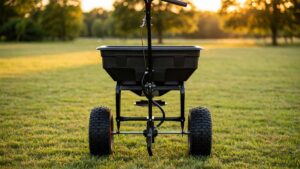
Seeding a new lawn puts a spreader to a particular kind of work: the ground is soft, the seed rate is light, and an uneven pass shows up weeks later as stripes. This guide compares best push broadcast spreaders with pneumatic wheels for newly seeded lawns using the figures the makers publish on their own product pages: hopper capacity, tire size, spread width, and the rate-control system.
Pneumatic tires are the heart of the keyword. An air-filled tire spreads the machine's weight over a wider contact patch than a solid plastic wheel, and it rolls over soft, freshly graded soil instead of cutting into it. Every spreader below states pneumatic tires on its opened page; models on solid or never-flat wheels were set aside during the research, however strong their other figures looked.
Three of the five picks are EarthWay models. That concentration reflects the market rather than a preference: EarthWay builds several push broadcast spreaders on pneumatic tires at homeowner and commercial sizes, and each model here is a distinct capacity class. The EarthWay 2150 also appears in this program's earlier general guide to broadcast spreaders for lawns, and that overlap is disclosed in its section.
Quick verdict
The EarthWay 2050P is the homeowner sweet spot: an 80-pound hopper, 10-inch pneumatic tires, side-spread control, and a pre-assembled arrival. The EarthWay 2150 adds 13-inch pneumatic stud tires and a feathered-edging spread system in a 50-pound commercial frame. The EarthWay 2170 doubles the hopper to 100 pounds for large seed jobs. The Agri-Fab 45-0614 is the biggest here at 130 pounds with a 10 to 12 foot spread width. The John Deere 60-pound spreader, built by Agri-Fab, is the ready-to-use option, pre-assembled with a cable flow control and a two-year limited warranty.
Comparison table
| Product | Key spec | Best for |
|---|---|---|
| EarthWay 2050P | 80 lb hopper, 10-in pneumatic tires, pre-assembled | Homeowners seeding a full lawn in one fill |
| EarthWay 2150 | 50 lb hopper, 13-in pneumatic stud tires | Soft seedbeds and precise edging |
| EarthWay 2170 | 100 lb hopper, 13-in pneumatic tires | Large new lawns with fewer refills |
| Agri-Fab 45-0614 | 130 lb hopper, 13 x 4 pneumatic tires, 10-12 ft spread | Half-acre seeding and overseeding |
| John Deere 60 lb | 60 lb hopper, 10 x 3.5 pneumatic tires, pre-assembled | Buyers who want no assembly at all |
How we chose
The tire gate came first. Each candidate's opened page had to state pneumatic tires in the maker's own copy or specification table. That single rule removed most of the push broadcast market, which runs on solid plastic wheels, and it also removed drop spreaders entirely, because this keyword asks for broadcast machines that throw material in a fan pattern. The genuine drop spreaders with pneumatic wheels are a separate, small family covered elsewhere in this program.
The second check was rate control. Grass seed goes down at a light rate compared with fertilizer, so the page was read for an adjustable rate setting and, where offered, side-spread control that keeps seed off paths, drives and flower beds. A newly seeded lawn also meets the spreader again a few weeks later for starter fertilizer, so a hopper and gearbox that tolerate damp material counted in a machine's favour, using only what the maker states about enclosed gearboxes and grate design.
The third check was size against the job. Hoppers here run from 50 to 130 pounds. A 50-pound hopper suits a small new lawn and stays light to push over soft soil; a 100-pound or 130-pound hopper cuts refill trips on a half-acre seeding but arrives at the seedbed carrying more weight on its tires. Both ends of that trade are represented, and the sections below state which lawn each size serves.
A word about the brand balance, since three EarthWay models in a list of five asks for an explanation. Push broadcast spreaders on pneumatic tires are a narrow shelf: most homeowner spreaders ride on solid wheels, most tow-behind models are a different machine type, and the walk-behind pneumatic class is served by a handful of makers. EarthWay builds three distinct capacity classes in that class, and each is a separate model with its own hopper, tire and control specification rather than a relabelled variant. The Agri-Fab and the Agri-Fab-built John Deere complete the set, so the group covers five genuinely different machines from three manufacturing sources, which is the honest shape of this market as the opened pages show it.
The products
EarthWay 2050P 80-pound broadcast spreader
- Hopper: 80 lb capacity, rustproof poly hopper
- Tires: 10-inch pneumatic tires
- Controls: side-spread control and adjustable drop rate
- Gearbox: fully enclosed
- Assembly: delivered pre-assembled
The 2050P is the model in this group that asks the least of its buyer before work starts: the maker states it arrives pre-assembled, so the first job is filling the hopper rather than bolting a frame together. The side-spread control matters on a newly seeded lawn, where the pass along a path or a bed edge decides whether seed lands on soil or on concrete. The enclosed gearbox is the maker's stated answer to damp conditions, and the rustproof poly hopper suits a machine that will also carry starter fertilizer later in the season. Its 10-inch tires are the smallest here, which keeps the machine compact; on very soft ground the larger tires of the 2150 and 2170 spread the load further. For seeding specifically, the adjustable drop rate is the working feature: grass seed is applied at a fraction of a fertilizer rate, and a control that adjusts at the spreader, as this page describes, lets the operator set that light rate and hold it across the whole lawn rather than guessing at a partly closed gate.
Pros:
- Arrives pre-assembled, ready to fill and push
- Side-spread control for clean edges along paths and beds
- 80 lb hopper covers a full homeowner lawn on one fill
Cons:
- 10-inch tires are the smallest in this group
- No spread width figure stated on the opened page
- Poly hopper at this size still gets heavy when filled with seed and fertilizer
EarthWay 2150 Commercial 50-pound broadcast spreader
- Hopper: 50 lb capacity
- Tires: 13-inch pneumatic stud tires with rustproof poly rims
- Spread system: 3-hole drop system with side-spread control and feathered edging
- Gearbox: fully enclosed
- Extras: clog-free grate that slides in and out
- Warranty: one-year limited warranty with lifetime technical support, as the maker words it
The 2150 is the precision pick. The maker describes its 3-hole drop system as producing an even pattern with feathered edging, which is exactly the behaviour a newly seeded lawn needs at its borders: full rate in the middle of the pass, fading rate at the edges, and side-spread control to keep seed off hard surfaces. The 13-inch pneumatic stud tires are the largest here alongside the 2170, and the maker presents them as high-flotation tires for rough, uneven patches, which describes a fresh seedbed well. The sliding grate keeps lumps of material from reaching the drop holes. This model also appears in this program's earlier general broadcast spreader guide; it returns here because its tire and edging figures fit this keyword directly, and the repeat is disclosed rather than hidden.
Pros:
- Feathered edging and side-spread control for accurate borders
- 13-inch pneumatic stud tires for soft, uneven seedbeds
- Sliding clog-free grate keeps the pattern even
Cons:
- 50 lb hopper is the smallest here, so large lawns mean refills
- Commercial build carries a higher price than homeowner models
- No spread width figure stated on the opened page
EarthWay 2170 Commercial 100-pound broadcast spreader
- Hopper: 100 lb capacity, 3,350 cubic inches
- Tires: 13-inch pneumatic tires
- Frame: durable coated frame with adjustable handle
- Gearbox: super-duty enclosed gearbox
- Weight: 25 pounds listed for the machine itself
The 2170 is the capacity step in the EarthWay line: double the 2150's hopper on the same 13-inch pneumatic tires, with an adjustable handle so the push height can be set for the operator. For a large new lawn, the value is arithmetic: half the refill stops, and each refill stop on a seedbed is a place where seed gets double-dosed or spilled. The maker lists the machine itself at 25 pounds, light for its class, though a full 100-pound load of seed changes the pushing effort on soft soil, and the sections of a big lawn are best filled partway per pass. One research note: the listing's specification block contains a line describing a nylon bag hopper that belongs to a different product type; the figures used here come from the title, the maker's bullets and the capacity fields, which agree with each other, and the stray line is flagged in the research notes.
Pros:
- 100 lb hopper halves refill stops on large seed jobs
- 13-inch pneumatic tires shared with the 2150
- Adjustable handle and a light 25 lb machine weight
Cons:
- A full hopper is heavy to push across soft, new soil
- Specification block contains a stray line from another product, flagged in the notes
- No spread width figure stated on the opened page
Agri-Fab 45-0614 130-pound push broadcast spreader
- Hopper: 130 lb capacity, rated by the maker for half an acre or 25,000 square feet
- Tires: 13 x 4 inch pneumatic tires
- Spread width: 10 to 12 feet
- Controls: direct rod flow control lever
- Weight: 22 pounds listed
- Dimensions: 48 x 27.2 x 33.7 inches listed
- Origin: made in the USA, as the maker states
The Agri-Fab is the biggest machine here and the only one whose page states a spread width: 10 to 12 feet, which on a new lawn means fewer passes and fewer chances to overlap or miss a strip. The direct rod control is a simple, positive linkage between the handle lever and the hopper gate, easy to set at the light rates grass seed needs. At 22 pounds listed, the machine itself is the lightest of the large hoppers, though as with the 2170, the load in the hopper dominates the effort on soft ground. For a half-acre seeding, this is the model that finishes on the fewest fills; for a small lawn it is more spreader than the job requires.
Pros:
- Largest hopper here at 130 lb, rated for 25,000 square feet
- Only model stating a spread width: 10 to 12 feet
- Direct rod control is simple to set at light seed rates
Cons:
- Oversized for small lawns, and a full load is heavy on soft soil
- No side-spread control system described on the page
- Largest storage footprint in the group
John Deere 60-pound push broadcast spreader, built by Agri-Fab
- Hopper: 60 lb capacity, no-rust poly hopper
- Tires: 10 x 3.5 inch pneumatic tires, per the maker's bullets
- Controls: cable flow control with a steel U-shaped push handle
- Coverage: up to 11,000 square feet, as the maker states
- Assembly: pre-assembled design
- Warranty: two-year limited warranty stated on the page
The John Deere entry is built by Agri-Fab in Sullivan, Illinois, as its page states, and it is aimed at the buyer who wants to unbox and spread. The maker describes a pre-assembled design, a cable flow control, and coverage up to 11,000 square feet, which matches a typical suburban new lawn in one or two fills. The steel U-shaped handle is the other detail its page emphasises, a closed loop grip that gives both hands a purchase on soft ground, where a spreader is steadied as much as it is pushed. Its two-year limited warranty is the longest stated in this group, against the EarthWay 2150's one year, which counts for a machine that will also be asked to spread ice melt in winter, as this page names among its uses. One caution from the research: the listing's specification table conflicts with its own title and bullets, listing a larger hopper and a larger tire size in the table fields. The figures used in this article are the title's 60-pound capacity and the bullets' 10 x 3.5 inch pneumatic tires, and the conflict is flagged in the research notes for this batch so a buyer can confirm at the size selector.
Pros:
- Pre-assembled, with a cable flow control and steel U-handle
- 60 lb hopper sized for a typical suburban lawn
- Two-year limited warranty, the longest stated here
Cons:
- Specification table conflicts with the title and bullets, flagged in the notes
- 10-inch tires are at the small end for very soft ground
- No spread width figure stated on the opened page
Buying guide
Match the hopper to the lawn first. A newly seeded lawn under about 10,000 square feet is served well by the 50 to 80 pound class: the EarthWay 2150, the John Deere and the EarthWay 2050P. Between 10,000 and 25,000 square feet, the 100-pound EarthWay 2170 and the 130-pound Agri-Fab cut the refill stops that cause most seeding mistakes, because every stop and restart on a seedbed risks a double dose at the overlap.
Look at the edging system next. Seed that lands on a path is wasted, and seed that lands thick at a border grows in a visible line. Side-spread control, offered by the EarthWay models here, closes the pattern on one side for a clean pass along hard surfaces. The EarthWay 2150's feathered edging goes further, fading the rate at the pattern edge. The Agri-Fab and John Deere pages do not describe an equivalent system, so border passes with those machines are made by walking the edge at a reduced rate setting instead.
Tire size decides how gently the machine rides over soft soil. The 13-inch pneumatic tires on the EarthWay 2150 and 2170 and the Agri-Fab roll over a fresh seedbed with a longer contact patch than the 10-inch tires on the 2050P and the John Deere. On firm, established ground the difference shrinks; on a new lawn in its first week, the larger tire is the kinder choice, and half-filling the hopper on the softest ground reduces the load further on any model.
Rate setting deserves its own paragraph, because seeding is where spreaders earn or lose their reputation. Seed is light, expensive per pound, and unforgiving of overlap: a double pass shows as a dark green stripe for a full season. The practical method the makers' controls support is a half-rate setting walked in two directions, across and then along the lawn, so no single pass carries the whole dose and a missed strip in one direction is covered by the other. The EarthWay models adjust the drop rate at the machine, the Agri-Fab uses its direct rod lever, and the John Deere its cable control; each system can hold a half rate, and the sections above record which control each page describes. Whichever model is chosen, the setting for a given seed is read from the seed maker's own label for that product, since rates differ between grass species and blends.
Finally, think past seeding day. The same machine will spread starter fertilizer a few weeks later and may spread ice melt in winter, a use the Agri-Fab and John Deere pages both name. An enclosed gearbox and a rustproof poly hopper, stated on the EarthWay pages, are the features that decide how the machine ages under that work.
FAQ
Why pneumatic tires for a newly seeded lawn?
The makers of the 13-inch models describe their pneumatic tires as high-flotation designs for rough, uneven ground. An air-filled tire presents a wider contact patch than a solid wheel, so the spreader's weight is spread over more soil, and the machine rolls across a soft seedbed instead of digging a track through it.
What spreader size suits a half-acre of new seed?
The Agri-Fab 45-0614 is rated by its maker for half an acre, or 25,000 square feet, from its 130-pound hopper. The EarthWay 2170, at 100 pounds, covers the same ground with one extra refill. Both ride on 13-inch pneumatic tires.
Can these spreaders apply starter fertilizer as well as seed?
Yes, as the pages describe them. Each model is a broadcast spreader for seed and fertilizer with an adjustable rate, and the Agri-Fab and John Deere pages also name salt and ice melt among their materials. The rate setting, not the machine, changes between products.
Which models arrive pre-assembled?
The EarthWay 2050P and the John Deere both state a pre-assembled or ready-to-use design on their pages. The other models in this group involve some assembly before the first fill.
Can these spreaders be used on an established lawn too?
Yes. Nothing in these five designs is specific to new seed: each is a general broadcast spreader for seed and fertilizer with an adjustable rate, as its page describes. The pneumatic tires and edging controls that suit a seedbed serve an established lawn the same way, and the larger models here are the same machines a homeowner would choose for routine feeding of a big lawn.
Are drop spreaders with pneumatic wheels covered here?
No. This keyword asks for push broadcast spreaders, which throw material in a fan. The genuine drop spreaders on pneumatic wheels form a separate small family, covered in this program's drop spreader guides, and they were excluded here on type rather than on quality.
Conclusion
For a newly seeded lawn, the spreader has to be gentle on soft soil, accurate at the borders, and honest at light rates. The EarthWay 2050P is the balanced homeowner choice, the 2150 is the precision tool for edging, the 2170 and the Agri-Fab 45-0614 scale up to large seed jobs, and the John Deere removes assembly from the day entirely. Every figure above, from hopper capacity to tire size, comes from the maker's own product page, including the two places where a page disagreed with itself and the conflict is flagged in the research notes instead of smoothed over.
Write Your Review
No reviews yet. Be the first to share your experience!