
Key takeaways
- Commercial broadcast spreaders with pneumatic wheels for steep sloping lawns: hopper sizes, tire sizes, gearboxes and weights compared from maker specs here.
What's inside
As an Amazon Associate I earn from qualifying purchases. This post may contain affiliate links at no extra cost to you.
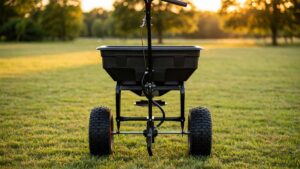
A broadcast spreader on a steep lawn works against gravity twice: the loaded hopper wants to tip and run away downhill, and the wheels have to keep grip and a true line while the operator walks across or up the slope. Air-filled pneumatic tires are the feature that ties this roundup together, because a pneumatic tire flexes over roots, stones and dry ruts instead of bouncing across them, and its wider footprint spreads the load on turf that is already stressed by the gradient. Every spreader below has pneumatic wheels stated by its maker — that was a hard requirement, not a preference — and every other figure quoted comes from the maker's own listing, manual or catalogue.
Hopper capacity runs from 40 to 80 pounds here, and that spread matters on a slope: a big hopper means fewer refill trips back up the hill, but a full 80-pound hopper plus the spreader is a serious load to hold on a bank. Weights, gear systems, deflector and edge-control features are therefore compared alongside capacity, because on steep ground the spreader you can control beats the spreader that merely holds the most.
If you are comparing the best commercial broadcast spreaders with pneumatic wheels for steep sloping lawns, start with tire size and gearbox protection, then match hopper size to the length of your slope runs.
Quick verdict
The Chapin 8301C Contractor Turf is the capacity pick: an 80-pound hopper, wide-tread 12-inch pneumatic tires and an enclosed all-metal gear system on a powder-coated steel frame. The Brinly P20-500BHDF-A brings 12 by 3 inch pneumatic turf-tread tires, a fully enclosed gearbox and a side deflector kit in a 50-pound rust-proof hopper at 28.5 pounds. Echo's RB-60 is the balanced commercial unit — 60-pound hopper, 10-inch pneumatic tires, 22.4-pound dry weight and a five-year consumer warranty. The EarthWay 2600A-Plus is the lightest machine here at 15 pounds with 9-inch pneumatic high-flotation tires and edge control. The Yard Commander pairs a 50-pound hopper with 12-inch pneumatic studded tires and an enclosed gearbox, and includes a hopper cover.
How we chose
Pneumatic wheels were the gate. Several well-known commercial spreaders were set aside because their listings did not state pneumatic tires, and tow-behind models were excluded entirely — a towed spreader on a steep lawn follows the slope on its own terms and cannot be held back by the operator the way a walk-behind can. Each pick below states air-filled tires in its own documentation, with sizes from 9 to 12 inches.
Gear protection came next. Broadcast spreaders live in fertilizer dust, which is corrosive and works into open gear teeth. Four of the five picks enclose their gear system fully — the Chapin in an all-metal enclosed housing, the Brinly and Yard Commander in fully enclosed gearboxes, and the EarthWay behind its three-hole drop shut-off design. An enclosed gearbox is worth more on a slope than anywhere else, because a spreader that starts skipping or binding mid-bank leaves stripes exactly where correcting them is hardest.
Control features were the third filter: spread pattern control, side deflectors and edge shut-off systems. On a slope, material thrown downhill travels further, so a deflector or pattern control that trims the downhill side keeps fertilizer and seed out of beds, paths and water. The Chapin offers spread pattern control and an adjustable rotary gate; the Brinly ships with a side deflector kit; the Echo has a side deflector; the EarthWay's SideSpread-Control closes the inner ports to hold an edge.
Finally, weight and hopper size were weighed together. Stated machine weights here run from 15 to 28.5 pounds before material. Add a full hopper and the totals range from roughly 55 to over 100 pounds of machine and load. On a steep lawn, the honest question is not which spreader holds the most but which total you can hold on the bank for a full pass — the roundup gives you both ends of that range.
| Model | Hopper | Pneumatic tires | Machine weight | Gear system |
|---|---|---|---|---|
| Chapin 8301C Contractor Turf | 80 lb | 12 in wide-tread | Not stated in sources read | Enclosed all-metal |
| Brinly P20-500BHDF-A | 50 lb | 12 x 3 in turf tread | 28.5 lb | Fully enclosed, rust-resistant |
| Echo RB-60 | 60 lb | 10 in | 22.4 lb dry | Gear-driven spinner (manual) |
| EarthWay 2600A-Plus | 40 lb | 9 in high-flotation | 15 lb | EV-N-SPRED 3-hole drop shut-off |
| Yard Commander YTL-002-001 | 50 lb | 12 in studded high-flotation | 26.4 lb | Fully enclosed |
Chapin 8301C Contractor Turf Spreader
The 8301C is Chapin's contractor-grade turf spreader, built around an 80-pound hopper — the largest in this roundup — on a powder-coated steel frame. Its wide-tread pneumatic tires measure 12 inches, the joint-largest here, and the wide tread pattern is the right shape for holding a line across a slope face: more rubber in contact with the turf, spread over a broader patch. The gear system is enclosed and all-metal, and the gate linkage is solid steel rather than a cable, which matters on a bank because cable linkages stretch and flex when the operator is hauling the machine sideways; a solid linkage keeps the gate setting where it was set.
Control is the other strength. The 8301C offers spread pattern control, so the throw can be biased away from the downhill side, and an adjustable rotary gate for rate setting. A retailer listing for the same model adds a spread width figure of 100 inches and a bail system for gate operation. A spike auger agitator keeps material moving in the hopper. The sources read for this roundup did not state the machine's own weight; with 80 pounds of material aboard, expect the total to be the heaviest here, and plan slope work in part-loads if the bank is severe. For long commercial runs on big sloping lawns, the capacity and the enclosed metal gears are the argument.
- Hopper: 80 lb
- Tires: 12 in pneumatic, wide tread
- Gear system: enclosed, all-metal
- Frame: powder-coated steel
- Linkage: solid steel gate linkage
- Controls: adjustable rotary gate, spread pattern control
- Agitator: spike auger
Pros
- Largest hopper here at 80 lb for long slope runs between refills
- Enclosed all-metal gears and solid steel linkage for commercial duty
- Spread pattern control to trim the downhill throw
Cons
- Machine weight not stated in the sources read, and a full load is heavy on a bank
- Steel frame needs rinsing after fertilizer use to protect the coating
Brinly P20-500BHDF-A Push Spreader
Brinly's 50-pound spreader rides on 12 by 3 inch pneumatic tires with a turf tread — the widest tire section in this group, which puts a broad, soft footprint under the load and is kind to thin slope turf. The hopper is rust-proof, the gearbox is fully enclosed and rust-resistant, and the hardware, shaft and agitator are stainless steel, a specification aimed squarely at fertilizer corrosion. At 28.5 pounds as listed, it is the heaviest empty machine here, but that weight is frame and hardware rather than hopper size, and it sits low over the wide tires.
Two included extras suit slope work directly. The side deflector kit lets you close down the throw on one side — the downhill side, or the side facing a bed or a path — without changing the gate rate. The hopper grate keeps lumps and bag scraps out of the gate while you are working at an angle, when material shifts and surges toward the opening. Brinly describes the model as part of its push-spreader line built for year-round material, and the enclosed drive means the gear teeth are not grinding fertilizer dust on every pass. For a homeowner-contractor crossover on steep ground, this is the most corrosion-proofed specification in the roundup.
- Hopper: 50 lb, rust-proof
- Tires: 12 x 3 in pneumatic, turf tread
- Item weight: 28.5 lb as listed
- Gearbox: fully enclosed, rust-resistant
- Hardware: stainless steel hardware, shaft and agitator
- Included: side deflector kit, hopper grate
Pros
- Widest pneumatic tires here for a soft, gripping footprint
- Stainless hardware and enclosed gearbox for fertilizer duty
- Side deflector kit included for edge and downhill control
Cons
- Heaviest empty machine in the group at 28.5 lb
- Hopper is mid-pack at 50 lb, so big jobs mean more refills than the Chapin
Echo RB-60 Broadcast Spreader
Echo's RB-60 is the professional landscape model in this list, and its manual gives the most complete specification of any pick here. The hopper holds 60 pounds; the pneumatic tires are 10 inches, with a recommended inflation pressure of 15 psi stated in the manual — a detail worth having on slopes, because an under-inflated tire squirms on side-hills and an over-inflated one bounces. Dry weight is 22.4 pounds, lighter than the Brinly despite the larger hopper. Echo states a spread pattern of up to 8 feet and coverage of 25,000 square feet per load, which lets you plan slope passes in full-width runs.
The frame is powder-coated steel with a commercial T-handle, the agitator is a heavy-duty design, and a side deflector is fitted for edge work. Echo backs the RB-60 with a five-year consumer warranty and a two-year commercial warranty per its published warranty statement, the longest consumer cover in this roundup. On steep lawns the combination that counts is the mid-weight build, the stated tire pressure and the deflector: set the pressure, close the downhill side with the deflector, and the 60-pound hopper is large enough to finish most residential slopes on one fill while staying holdable on the bank.
- Hopper: 60 lb (36.8 L)
- Tires: 10 in pneumatic; 15 psi recommended in the manual
- Dry weight: 22.4 lb per manual
- Spread pattern: up to 8 ft
- Coverage: 25,000 sq ft per load, as stated
- Frame: powder-coated steel, commercial T-handle
- Extras: side deflector, heavy-duty agitator
- Warranty: 5-year consumer, as published
Pros
- Full manual specification, including tire pressure for slope setup
- 60 lb hopper at a moderate 22.4 lb dry weight
- Five-year consumer warranty, the longest here
Cons
- 10 in tires are smaller than the 12 in sets on the Chapin, Brinly and Yard Commander
- Spread pattern of 8 ft is narrower than the widest here, so more passes on big lawns
EarthWay 2600A-Plus Estate Broadcast Spreader
The 2600A-Plus is the light machine of the group: 15 pounds as listed, roughly half the Brinly's weight, on 9-inch pneumatic high-flotation tires. For steep lawns that single figure changes how the spreader gets used — a 15-pound machine with a 40-pound hopper can be carried to the top of a bank, worked across short contour runs, and hauled back up without the operator fighting the equipment between passes. The hopper is rust-proof polypropylene and the frame is epoxy-coated steel, so the corrosion bases are covered despite the light build.
EarthWay's metering is its EV-N-SPRED three-hole drop shut-off system, designed to hold an even rate, and the solid linkage control sets the rate without cable stretch. The feature that earns this spreader its slope place is SideSpread-Control, which closes the inner two ports so material feeds only to one side — the tool for holding an edge along the top of a bank, a bed line or a path, where downhill throw would waste material. The trade is size: 9-inch tires roll over rough ground less easily than 12-inch ones, and the 40-pound hopper is the smallest here. On short, steep, awkward banks, light and controllable wins; on long runs, it means refills.
- Hopper: 40 lb, rust-proof polypropylene
- Tires: 9 in pneumatic, high-flotation
- Item weight: 15 lb as listed
- Metering: EV-N-SPRED 3-hole drop shut-off
- Edge control: SideSpread-Control
- Frame: epoxy-coated steel
- Handle and linkage: steel T-handle, solid linkage
Pros
- Lightest here at 15 lb, the easiest to carry and hold on a bank
- SideSpread-Control holds edges along beds, paths and bank tops
- Rust-proof hopper and coated frame for fertilizer use
Cons
- Smallest hopper here at 40 lb, so more refill trips on long runs
- 9 in tires are the smallest here and feel rough ground more
Yard Commander 50 LB Walk-Behind Broadcast Spreader
The Yard Commander YTL-002-001 pairs a 50-pound corrosion-resistant composite hopper with 12-inch pneumatic tires in a studded high-flotation pattern — the studs are the slope detail, biting into dry, hard or lightly loose surfaces where a smooth turf tread can slide. The spreader weighs 26.4 pounds as listed and spreads an adjustable 10 to 12 feet, the widest stated throw in this roundup, which shortens the pass count on broad slope faces. The gearbox is fully enclosed, and a grate inside the hopper is shaped to keep material flowing without clogging at the gate.
A hopper cover is included, which matters more on slopes than on the flat: it keeps material in the hopper when the machine tilts and lurches, and keeps dew and drizzle off fertilizer during a session. The listing states a one-year warranty. Against the Brinly — its closest match on paper — the Yard Commander trades stainless hardware for the studded tire pattern and the wider stated spread. For sloping lawns with hard or worn surfaces where grip is the limiting factor, the studded pneumatic tire is a deliberate answer.
- Hopper: 50 lb, corrosion-resistant composite
- Tires: 12 in pneumatic, studded high-flotation
- Item weight: 26.4 lb as listed
- Spread: adjustable 10–12 ft
- Gearbox: fully enclosed
- Included: hopper cover, clog-free hopper grate
- Warranty: 1 year, as listed
Pros
- Studded 12 in pneumatic tires for grip on hard, worn slopes
- Widest stated spread here at 10–12 ft
- Hopper cover included, useful when the machine tilts on a bank
Cons
- One-year warranty is the shortest stated here
- No side deflector listed, so edge control relies on pattern adjustment
Buying guide
Size the tires to the slope, not the lawn. On steep ground the tire is the suspension, the brake and the steering. Twelve-inch pneumatic tires roll over roots and stones with less deflection and put more rubber on the turf; 9-inch tires are lighter and nimbler but get knocked off line more easily. If your banks are smooth and short, the lighter machines work. If the slope is long, rough or rutted, take the bigger wheels and accept the weight.
Count the total load, not the hopper size. Add machine weight to a full hopper: roughly 55 pounds for the EarthWay, about 78 for the Brinly and Yard Commander, over 80 for the Echo, and past 100 for a full Chapin. On a steep bank you hold that load with your legs and your grip for every pass. A practical approach for severe slopes is to run the big-hopper machines part-full — capacity you can leave unused beats a small hopper you must refill at the bottom of the hill every time.
Enclosed gears are worth paying for. Fertilizer dust is corrosive and abrasive, and slope work shakes more of it into the mechanism. A fully enclosed gearbox or enclosed all-metal gear housing keeps the teeth clean and the rate consistent. Whatever you choose, rinse the hopper, gate and spinner after fertilizer sessions and let the machine dry before storing it; the stainless hardware on the Brinly and the rust-proof hoppers on the Brinly and EarthWay reduce the burden but do not remove it.
Plan the pattern before you start. On a slope, thrown material travels further downhill and shorter uphill, so the pattern stretches. Work across the slope in contour passes rather than straight up and down where the ground allows, overlap passes by eye against the stretched downhill edge, and use a deflector or edge-control system on the downhill side near beds, paths and drains. The Chapin's pattern control, the Brinly's deflector kit, the Echo's side deflector and the EarthWay's SideSpread-Control all exist for exactly this adjustment.
Check tire pressure as part of setup. Pneumatic tires only do their job at the right pressure. Echo's manual states 15 psi for the RB-60; for the others, follow the pressure marked on the tire or in the manual. Under-inflated tires drag and wander on side-hills; over-inflated tires bounce and lose the grip that makes pneumatic tires worth having on a bank in the first place.
Match the spreader to the material. Wide stated spreads — 10 to 12 feet on the Yard Commander — suit seed and granular fertilizer on broad faces. Heavier or damp-prone materials flow better through large gates with strong agitators, like the Chapin's spike auger and the Echo's heavy-duty agitator. If you spread salt or ice melt in winter as well, the enclosed gearboxes and corrosion-resistant hoppers in this list are the ones that will shrug it off, with a thorough rinse afterwards.
FAQ
Why do pneumatic tires matter so much on a slope?
An air-filled tire flexes around stones and roots instead of bouncing off them, so the spreader holds its line and the spinner plate stays level enough for an even throw. The wider footprint also spreads the loaded weight, which helps the tire grip instead of slicing into soft turf on a bank. Solid wheels are lighter and never puncture, but on steep, rough ground they skip and chatter.
Should I walk up and down the slope or across it?
Across the slope in contour passes, where the ground allows it safely, gives the most even result: the downhill stretch of the pattern stays consistent from pass to pass. Walking straight up and down means the pattern compresses uphill and stretches downhill within every run, and the loaded spreader pulls hardest against you on the descent. On very steep banks, shorter contour runs with part-filled hoppers are the manageable pattern.
How full should the hopper be on steep ground?
Full enough to finish a set of passes without a mid-bank refill, light enough that you can hold the machine steady at the steepest point. For most people that means part-filling the big 80-pound Chapin and running the smaller hoppers full. Material left in the hopper should go back in the bag at the end of the session rather than sitting in the machine.
Do I need a deflector if my slope borders a flower bed?
It is the simplest way to keep granular material out of the bed. A deflector or an edge-control shut-off trims the throw on the bed side while the open side keeps its full rate, so you can work right up to the edge in one pass instead of leaving a wide untreated margin and coming back with a hand spreader.
How do I keep the rate even when the spreader tilts?
Keep your walking speed steady, since broadcast rate per area depends on ground speed as much as gate setting. Tilt changes how material feeds to the gate, so avoid sudden lurches, keep the hopper grate in place to break up surges, and overlap passes slightly. Checking the gate setting on the flat before you start, and again after the first slope pass, catches most drift.
Conclusion
For long commercial runs on big sloping lawns, the Chapin 8301C's 80-pound hopper, enclosed metal gears and pattern control make it the capacity leader. The Brinly P20-500BHDF-A is the corrosion-fighter, with the widest pneumatic tires, stainless hardware and a deflector kit included. Echo's RB-60 is the balanced professional choice with a full manual specification and the longest consumer warranty. The EarthWay 2600A-Plus trades size for a 15-pound build that is easy to carry and hold on short, steep banks, and the Yard Commander's studded 12-inch tires answer slopes where grip, not comfort, is the limit. Match the total loaded weight to the bank you actually have, and any of these five will spread it evenly.
Write Your Review
No reviews yet. Be the first to share your experience!